
- All
- Product Name
- Product Keyword
- Product Model
- Product Summary
- Product Description
- Multi Field Search


Views: 0 Author: Site Editor Publish Time: 2026-09-01 Origin: Site


As the global demand for rechargeable batteries continues to grow, lithium-ion batteries remain the dominant technology for electric vehicles, energy storage systems, portable electronics and many other applications. At the same time, the battery industry is actively developing alternative chemistries that can improve supply-chain flexibility, cost stability and performance in specific operating environments.
One of the technologies receiving increasing attention is the sodium-ion battery.
Unlike lithium-ion batteries, sodium-ion batteries use sodium ions (Na⁺) as the charge carriers. The basic electrochemical principle is similar to lithium-ion technology, but the materials, cell chemistry and performance characteristics are different.
At MICA POWER, we view sodium-ion batteries not as a simple replacement for lithium-ion batteries, but as another important battery chemistry designed to solve different energy-storage requirements.
So, what exactly is a sodium-ion battery? How does it work? What are its advantages and limitations? And where does sodium-ion technology make the most sense?
This guide explains the technology in practical terms.
A sodium-ion battery (SIB or Na-ion battery) is a rechargeable battery that stores and releases electrical energy through the reversible movement of sodium ions between the cathode and anode.
The operating principle is similar to that of a conventional lithium-ion battery.
During charging:
Na⁺ ions move from the cathode → through the electrolyte → to the anode.
During discharging:
Na⁺ ions move from the anode → through the electrolyte → back to the cathode.
At the same time, electrons travel through the external circuit, generating usable electrical power.
The main difference is that sodium ions replace lithium ions as the charge carriers.
The U.S. Department of Energy describes sodium-ion batteries as electrochemically similar to lithium-ion batteries, typically using a cathode, hard-carbon or other anode materials, separator and electrolyte.
This similarity is important because sodium-ion technology can benefit from manufacturing knowledge and processes developed for the lithium-ion battery industry.
A typical sodium-ion battery contains four major components:
Cathode
Anode
Electrolyte
Separator
There are also current collectors, housing materials, terminals and, in a finished battery pack, a Battery Management System (BMS).
The cathode is one of the most important components determining the voltage, capacity, power capability and overall performance of a sodium-ion cell.
Several cathode families are being developed, including:
Layered metal oxides
Prussian blue and Prussian blue analogues
Polyanionic compounds
Different chemistries offer different combinations of energy density, cycle life, power capability, cost and material availability.
Commercial sodium-ion batteries commonly use hard carbon as the anode material.
This is an important difference from conventional graphite-based lithium-ion batteries.
Hard carbon provides a structure that allows sodium ions to be stored and released during charge and discharge.
However, improving hard-carbon capacity, density and long-term performance remains an active area of sodium-ion battery research. Recent research reviews identify anode development as one of the key routes to improving the energy density of sodium-ion batteries.
The electrolyte provides the pathway through which sodium ions move between the electrodes.
Depending on the chemistry and design, sodium-ion batteries can use liquid or other electrolyte systems.
The electrolyte influences:
Ionic conductivity
Operating temperature
Charging performance
Safety
Cycle life
High-voltage stability
The separator physically separates the cathode and anode while allowing sodium ions to pass through.
It is essential for preventing internal short circuits while maintaining ion transport.
The easiest way to understand sodium-ion technology is to compare it with lithium-ion batteries.
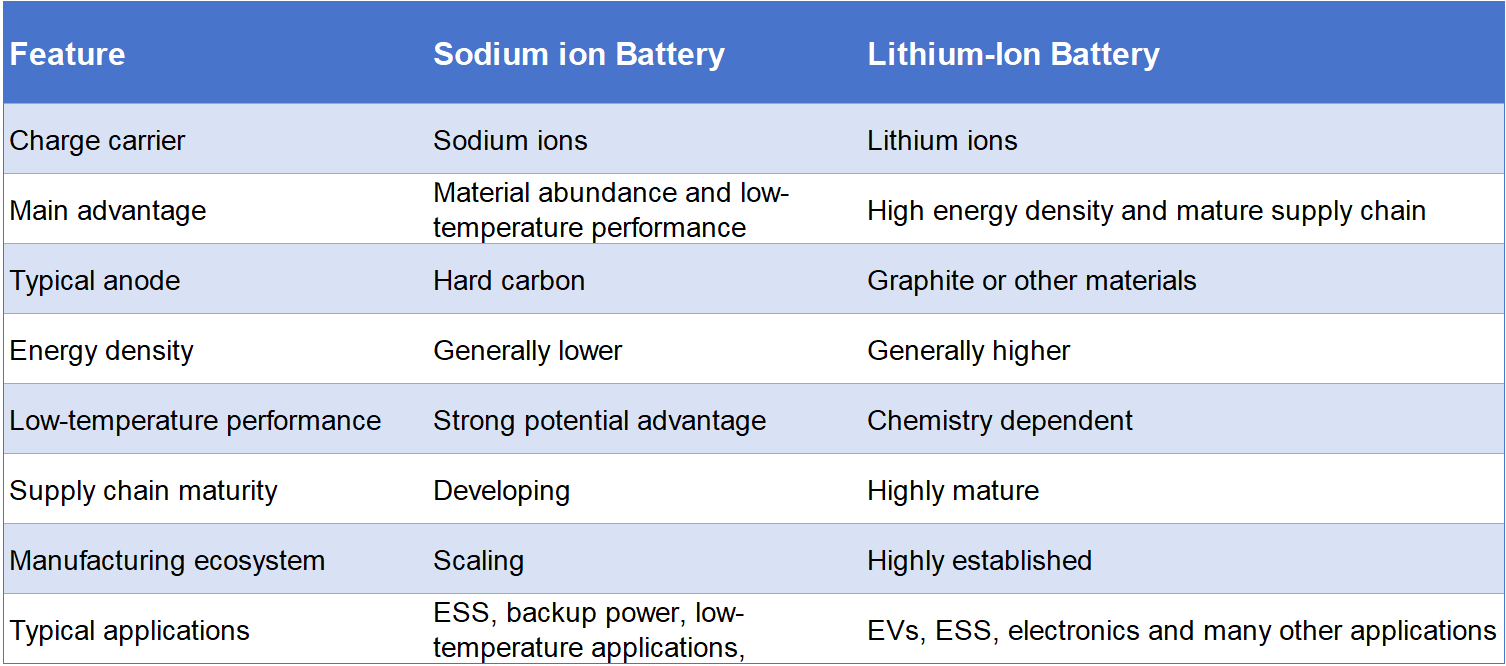
It is important not to treat the comparison as simply “sodium vs lithium.”
Different lithium-ion chemistries also have very different characteristics.
For example, LFP batteries have different energy density and temperature behaviour from NMC batteries. Similarly, sodium-ion performance varies significantly depending on cell chemistry and generation.
According to the IEA's 2026 analysis, the latest sodium-ion cells can reach around 175 Wh/kg, while the cited upper ranges for LFP and NMC lithium-ion technologies are higher. The IEA also highlights the particularly strong low-temperature performance of newer sodium-ion cells.
There are several reasons.
Sodium is widely available and does not depend on lithium resources in the same way as lithium-ion technology.
This makes sodium-ion technology attractive from a resource diversification and supply-chain perspective.
However, it would be inaccurate to say that sodium-ion batteries completely eliminate critical-mineral supply-chain issues. Depending on the chemistry, sodium-ion batteries can still use materials such as manganese, nickel or other metals.
Therefore, the more accurate description is:
Sodium-ion batteries can diversify battery material supply chains rather than completely eliminate material-supply risks.
The IEA similarly notes that sodium-ion batteries do not require lithium or graphite, but some commercial chemistries can still involve other critical minerals and their downstream manufacturing supply chain remains concentrated.
One of the most interesting characteristics of sodium-ion technology is its performance in cold environments.
Low temperatures can significantly affect the charging and discharging performance of many lithium-ion batteries.
New-generation sodium-ion batteries are being developed with improved low-temperature characteristics. The IEA reports that some latest-generation sodium-ion cells can retain around 90% of nominal capacity at temperatures as low as -40°C, although actual performance depends on the specific cell and system design.
This creates opportunities in applications such as:
Cold-climate energy storage
Outdoor equipment
Backup power
Telecom systems
Low-temperature industrial equipment
Certain electric mobility applications
For these applications, energy density is not always the only priority.
From an engineering perspective, sodium-ion batteries have several potential advantages.
The most obvious difference is that sodium-ion batteries do not require lithium as the primary charge carrier.
This can help battery manufacturers diversify their material supply strategies.
Sodium-ion technology can provide attractive performance in cold environments, especially compared with some LFP applications.
Sodium itself is abundant and inexpensive. However, it would be premature to assume that every sodium-ion battery is automatically cheaper than every lithium-ion battery.
Cell cost depends on:
Cathode materials
Anode materials
Manufacturing scale
Production yield
Cell design
Energy density
Raw-material prices
Supply-chain maturity
The IEA notes that current sodium-ion batteries do not yet consistently undercut LFP batteries on cost, although the economics can become more attractive under particular conditions, including cold climates and changes in lithium prices.
Certain sodium-ion chemistries, particularly some Prussian blue analogue systems, can offer favourable ion transport characteristics and high-rate capability.
However, performance must always be evaluated at the cell level, rather than assuming that every sodium-ion chemistry has identical power capability.
Because sodium-ion batteries share many fundamental concepts with lithium-ion batteries, existing battery manufacturing knowledge can be adapted to sodium-ion production.
This is one reason the technology has progressed from laboratory research toward commercial-scale manufacturing.
Sodium-ion batteries are promising, but they are not a universal replacement for lithium-ion batteries.
This remains one of the biggest challenges.
Sodium ions are larger and heavier than lithium ions, and the associated electrode chemistry creates challenges for achieving the same energy density as advanced lithium-ion cells.
For applications where weight and volume are critical, such as:
Long-range EVs
Drones
Aviation
Portable electronics
energy density can be extremely important.
The IEA currently identifies lower energy density as one of the major limitations preventing sodium-ion batteries from competing directly with the best lithium-ion technologies across all applications.
Lithium-ion batteries have benefited from decades of commercial production, enormous manufacturing volumes and a highly developed global supply chain.
Sodium-ion batteries are at an earlier stage.
The IEA reported that global sodium-ion battery production in 2025 was still less than 1% of lithium-ion production, despite rapid investment and development.
As production scales up, manufacturing efficiency and supply-chain maturity will become increasingly important.
“Sodium-ion battery” is not one single chemistry.
For example, sodium-ion cells may use:
Layered oxide cathodes
Prussian blue analogues
Polyanionic cathodes
Different hard-carbon anodes
Different electrolyte formulations
Therefore, when evaluating a sodium-ion battery supplier, it is important to ask for actual technical specifications rather than relying only on the general advantages of sodium-ion technology.
The most suitable applications are those where cost, safety, temperature performance, service life and material availability are more important than achieving the highest possible energy density.
Stationary energy storage is one of the most promising areas.
For stationary applications, battery weight is often less critical than it is for electric vehicles.
Sodium-ion batteries can therefore be considered for:
Residential energy storage
Commercial energy storage
Renewable energy storage
Solar storage
Backup power
Telecom backup systems
Industrial energy storage
This is particularly relevant as global battery storage deployment continues to grow. The IEA reported that 108 GW of new battery storage capacity was deployed globally in 2025.
Applications exposed to cold environments are another potential market.
Examples include:
Outdoor monitoring equipment
Remote communication systems
Cold-region backup power
Outdoor lighting
Industrial equipment
Sodium-ion batteries are also entering the EV market.
The first sodium-ion-powered electric car was introduced in China in late 2023, and major battery manufacturers have since continued developing commercial sodium-ion products.
However, for long-range vehicles where maximum energy density is essential, advanced lithium-ion technologies remain highly relevant.
Sodium-ion technology is also being developed for smaller battery applications.
For example, MICA POWER is exploring sodium-ion battery solutions in compact formats such as 12V sodium-ion battery packs, where practical considerations can include compact design, stable output and operation in demanding environments.
Safety is a system-level issue, not simply a question of whether a battery is sodium-ion or lithium-ion.
Battery safety depends on:
Cell chemistry
Electrode materials
Electrolyte
Separator
Cell design
BMS
Charging strategy
Thermal management
Mechanical protection
Manufacturing quality
Some sodium-ion chemistries offer potential safety advantages, but it would be misleading to claim that all sodium-ion batteries are inherently safer than all lithium-ion batteries.
A professionally designed sodium-ion battery pack should still incorporate appropriate:
Overcharge protection
Over-discharge protection
Overcurrent protection
Short-circuit protection
Temperature monitoring
Cell balancing
BMS protection
At MICA POWER, we consider cell chemistry, pack structure and BMS design as an integrated system, rather than evaluating battery safety from chemistry alone.
Choosing between sodium-ion and lithium-ion technology should start with the application requirements.
Consider the following questions:
If yes, sodium-ion may deserve serious consideration.
If yes, lithium-ion may currently provide an advantage because of its higher energy density.
If yes, sodium-ion can be an interesting technology to evaluate.
Sodium-ion can provide another battery chemistry option.
Higher-energy-density lithium-ion technologies may remain more suitable.
In other words:
The best battery chemistry depends on the application—not simply on which chemistry is newer.
The sodium-ion industry is moving from research toward commercial scale.
According to the IEA, 2026 is an important period for sodium-ion scale-up, with major battery manufacturers expanding their commercialisation efforts. At the same time, the technology still needs improvements in energy density, manufacturing scale and supply-chain maturity.
Future development is likely to focus on several areas.
Researchers are working on improved cathode and anode materials, particularly advanced hard-carbon anodes.
Optimising ion transport and electrode structure could improve charging performance.
Improving electrode stability and reducing degradation will remain important for energy storage applications.
This is already one of sodium-ion's attractive characteristics and will continue to be an important development direction.
Large-scale manufacturing could improve production efficiency and help sodium-ion compete in more applications.
As sodium-ion cell formats mature, manufacturers will be able to develop more application-specific solutions rather than simply copying existing lithium-ion pack designs.
At MICA POWER, we believe the future of energy storage will not depend on a single battery chemistry.
Lithium-ion, LiFePO4, sodium-ion and other emerging technologies each have their own strengths and application scenarios.
For sodium-ion batteries, our focus is on translating cell-level advantages into practical battery pack solutions.
This includes considerations such as:
Cell selection
Battery voltage
Capacity
BMS configuration
Mechanical structure
Connector design
Charging requirements
Operating temperature
Protection functions
Application-specific packaging
For example, a compact 12V 4.5Ah sodium-ion battery may be designed very differently from a large stationary energy-storage battery, even though both use sodium-ion technology.
This application-oriented approach is important because a battery's real-world performance depends not only on the cell chemistry but also on how the complete battery pack is engineered.
No.
Although both involve sodium-related chemistry, a modern sodium-ion battery is an electrochemical rechargeable battery based on reversible sodium-ion movement between electrodes. It should not simply be treated as the same technology as a conventional saltwater battery.
Yes.
Sodium-ion batteries are rechargeable secondary batteries designed for repeated charge and discharge cycles.
There is no universal answer.
Sodium-ion batteries can offer advantages such as material diversification and strong low-temperature performance, while lithium-ion batteries currently have advantages in energy density, manufacturing scale and supply-chain maturity.
The right choice depends on the application.
In some applications, yes.
However, sodium-ion technology should currently be viewed as a complementary battery chemistry, rather than a complete replacement for LiFePO4.
Stationary storage, cold-climate applications and certain cost-sensitive applications may be particularly interesting areas.
A sodium-ion battery is designed around sodium ions rather than lithium ions as its primary charge carriers. However, the exact material composition depends on the cell chemistry and manufacturer.
Yes, they can be.
Solar energy storage is one of the applications where sodium-ion technology has potential because stationary systems are less sensitive to battery weight than EVs.
However, the final choice should consider the battery's energy density, cycle life, temperature range, efficiency, cost and warranty requirements.
Sodium-ion batteries are no longer only a laboratory concept.
Commercial products are emerging, major battery manufacturers are investing in production, and the technology is beginning to enter applications ranging from electric vehicles to stationary energy storage.
At the same time, sodium-ion technology still faces real challenges.
Its energy density is generally lower than advanced lithium-ion batteries, its manufacturing ecosystem is less mature, and its cost competitiveness depends heavily on chemistry, production scale and market conditions.
Therefore, the most realistic way to understand sodium-ion batteries is not:
“Sodium-ion will replace lithium-ion.”
Instead:
“Sodium-ion is becoming another important battery technology for applications where its particular characteristics provide practical value.”
As battery technology continues to diversify, the future energy-storage market is likely to include multiple chemistries working alongside each other.
For battery manufacturers such as MICA POWER, this creates an opportunity to develop application-specific solutions that match the battery chemistry to the customer's actual requirements.
Sodium-ion is not simply a substitute for lithium-ion. It is a new tool in the battery industry's toolbox—and its most valuable applications may be those where its unique characteristics matter most.
This article reflects current industry and technical information from the International Energy Agency (IEA), U.S. Department of Energy (DOE), and recent peer-reviewed research. The IEA's 2026 assessment is particularly useful for understanding the current commercialisation stage, energy-density gap and low-temperature characteristics of sodium-ion batteries.


