
- All
- Product Name
- Product Keyword
- Product Model
- Product Summary
- Product Description
- Multi Field Search


Views: 0 Author: Site Editor Publish Time: 2026-10-27 Origin: Site


Choosing a sodium-ion battery manufacturer is not simply a matter of finding a supplier with the lowest quotation.
As sodium-ion technology moves from research and pilot projects toward commercial production, buyers have more suppliers to consider. At the same time, the market is still relatively young compared with lithium-ion and lead-acid batteries.
That creates both an opportunity and a challenge.
The opportunity is that sodium-ion technology is developing quickly. The challenge is that not every company presenting itself as a “sodium-ion battery manufacturer” has the same level of technology, manufacturing capability, quality control or production experience.
At MICA POWER, we believe the right way to select a sodium-ion battery supplier is to evaluate the complete supply chain and engineering capability, not just the product catalog.
Before placing an order, I would want to know:
Who actually manufactures the cells?
Who assembles the battery pack?
What sodium-ion chemistry is being used?
What is the manufacturer's real production capability?
Can the supplier customize the battery?
How is the BMS designed?
What tests have been performed?
Which certifications are applicable?
Can the manufacturer provide traceability?
How are production changes controlled?
What happens if the product has a problem after shipment?
Can the supplier support the project for several years?
These questions become even more important because the sodium-ion supply chain is still developing. According to the IEA, global sodium-ion battery production in 2025 was less than 1% of lithium-ion production, while nearly all existing sodium-ion manufacturing capacity was located in China. IEA
So, how do you choose the right sodium-ion battery manufacturer?
My recommendation is to evaluate the supplier across technology, manufacturing, quality, testing, customization, certification, supply-chain stability and after-sales support.
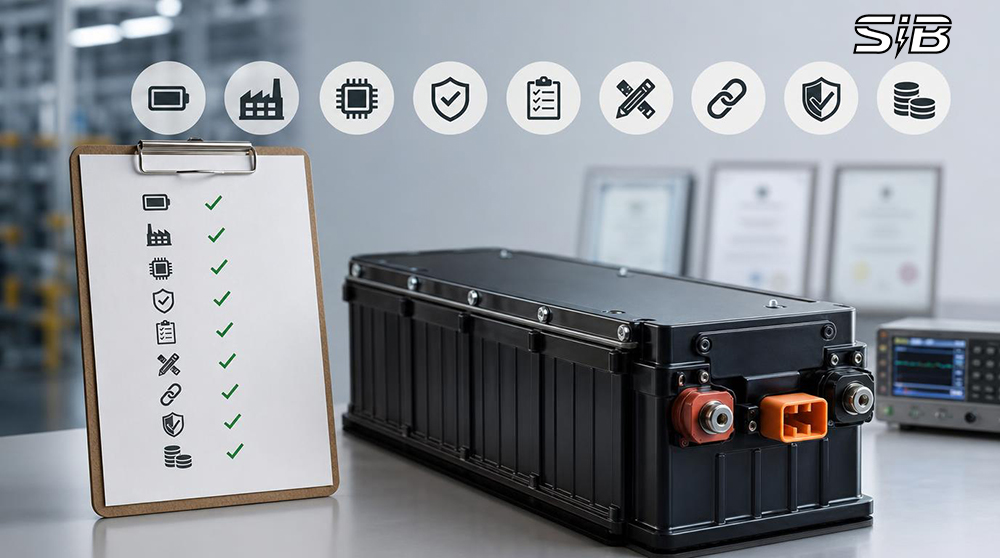
A battery is not simply a collection of cells.
A commercial battery system combines:
Cell + electrical design + BMS + mechanical structure + thermal management + protection + charging strategy + manufacturing process + testing
If any one of these elements is poorly designed, the performance of the final battery can be significantly different from the theoretical performance of the cell.
This is particularly important with sodium-ion batteries because the technology is still developing.
The IEA describes sodium-ion batteries as entering the scale-up phase, but also points out that their manufacturing capacity and supply chain are far less developed than those of lithium-ion batteries. IEA
For a buyer, this means that a supplier's actual manufacturing capability deserves as much attention as its technical claims.
A professional manufacturer should be able to explain not only what its battery can do, but also how it produces, tests and controls the battery.
I recommend evaluating a supplier through the following ten areas:
Cell technology and chemistry
Manufacturing capability
Quality management
Battery design and BMS
Performance testing
Safety and transportation certification
Customization capability
Supply-chain stability
Warranty and technical support
Total cost of ownership
No single factor should determine the decision.
A supplier with an excellent product but weak after-sales support may create problems later. Similarly, a supplier with an impressive factory but limited engineering customization may not be suitable for an OEM project.
The first question I ask is:
What cell is actually inside the battery?
“Sodium-ion battery” describes a battery technology family rather than one single cell design.
Different sodium-ion batteries can use different combinations of cathode, anode and electrolyte materials.
Common technology families include:
Layered oxide cathodes
Prussian blue / Prussian white analogues
Polyanionic materials
Hard-carbon anodes
Different electrolyte formulations
These differences can affect:
Energy density
Cycle life
Power capability
Low-temperature performance
Charging behavior
Safety
Cost
Service life
This is why I would never evaluate a sodium-ion supplier simply by asking, “What is your Wh/kg?”
I would ask for the actual cell model and technical datasheet.
The IEA currently reports that the latest sodium-ion cells can reach up to approximately 175 Wh/kg, compared with up to about 205 Wh/kg for the latest LFP cells. This illustrates both sodium-ion's progress and its current energy-density limitation. IEA
Before approving a supplier, ask:
Who manufactures the cell?
What is the exact cell model?
What is the nominal voltage?
What is the rated capacity?
What is the recommended charging current?
What is the continuous discharge current?
What is the peak discharge current?
What is the operating temperature range?
What is the storage temperature range?
What is the cycle-life test condition?
At what temperature was the cycle-life test performed?
What depth of discharge was used?
What end-of-life capacity was defined?
A manufacturer that cannot clearly answer these questions deserves further investigation before you commit to a large project.
This is one of the most important points in supplier selection.
There is a difference between:
Cell manufacturer
Battery-pack manufacturer
System integrator
Distributor
Trading company
A company can legitimately provide a battery solution without manufacturing the cells itself. That is not automatically a problem.
The problem occurs when a supplier's manufacturing role is unclear.
For an OEM customer, I recommend asking the supplier to explain its complete production chain.
For example:
Cell supplier → incoming inspection → cell grading → pack assembly → BMS installation → welding → insulation → aging → final testing → packaging → shipment
The more transparent this process is, the easier it becomes to evaluate the supplier.
This is especially relevant because the sodium-ion supply chain is still concentrated. The IEA reports that downstream sodium-ion production, including cells and key components, remains heavily concentrated in China. IEA
A factory visit can tell you things that a product catalog cannot.
When we receive customers at MICA POWER, we understand why they want to see the manufacturing process. A battery buyer is not only purchasing a product; they are choosing a manufacturing partner.
During a factory audit, I recommend looking at:
Check whether the company has dedicated battery assembly equipment and controlled production areas.
Look at how cells are stored, identified and managed.
Depending on the pack design, this may include:
Cell testing equipment
Sorting equipment
Welding equipment
Insulation equipment
BMS installation equipment
Pack assembly tools
Charging equipment
Aging equipment
A serious battery manufacturer should have appropriate testing equipment for the products it manufactures.
Ask to see how the company tests:
Voltage
Capacity
Internal resistance
Charge/discharge performance
BMS protection
Temperature behavior
Communication
Insulation
Mechanical integrity
A factory tour is not about seeing the newest machine.
It is about determining whether the manufacturer has a repeatable process.
A good battery manufacturer should be able to explain its quality-control process from incoming materials to final shipment.
I would divide quality control into at least four stages:
| Quality stage | What to evaluate |
Incoming inspection | Cell capacity, voltage, resistance, appearance and material identification |
In-process inspection | Welding, insulation, wiring, BMS installation and assembly consistency |
Aging/testing | Charge-discharge testing, protection testing and abnormal-condition checks |
Final inspection | Voltage, capacity, appearance, communication and packaging |
The key is not simply whether a supplier says:
“We have strict quality control.”
Ask:
“What exactly do you inspect, when do you inspect it, and how are the results recorded?”
That question often reveals the difference between a marketing statement and a real quality system.
For battery packs, the BMS is one of the most important components.
The BMS monitors and controls the battery to help protect it from operating outside specified electrical and temperature limits.
Depending on the application, BMS functions may include:
Overcharge protection
Over-discharge protection
Overcurrent protection
Short-circuit protection
Over-temperature protection
Low-temperature protection
Cell voltage monitoring
Temperature monitoring
SOC estimation
Communication
Cell balancing
For larger systems, communication may include:
CAN
RS485
Bluetooth
Other application-specific interfaces
A supplier should be able to explain which BMS is used and how its parameters are configured.
I would be cautious if a manufacturer treats the BMS as a generic accessory.
For an OEM project, the BMS needs to be considered together with the:
cell + charger + inverter + load + operating environment
This is where supplier qualification becomes much more objective.
Do not rely only on statements such as:
“Long cycle life”
or
“Excellent low-temperature performance.”
Ask for the test conditions.
For example, cycle-life data should ideally identify:
Charge method
Discharge method
Charge/discharge current
Temperature
Depth of discharge
Rest period
Number of cycles
End-of-life capacity threshold
Without these details, a cycle-life number is difficult to compare.
The same principle applies to low-temperature performance.
A statement such as “-40°C operation” does not tell you whether the battery can:
Discharge at -40°C
Charge at -40°C
Deliver rated capacity at -40°C
Deliver rated current at -40°C
Operate continuously at -40°C
Maintain cycle life at -40°C
These are completely different claims.
Certification should be evaluated according to the battery's intended market, transportation method and application.
For sodium-ion batteries, transportation requirements are particularly important.
The United Nations dangerous-goods testing framework has provisions covering sodium-ion cells and batteries under UN 38.3 testing requirements. UNECE documentation specifies testing requirements for sodium-ion cell and battery types. 联合国欧洲经济委员会
For certain automotive applications, there are also emerging sodium-ion-specific test guidelines.
For example, SAE International issued J3335_202609 in September 2026 as a recommended practice covering common test procedures for secondary sodium-ion cells used for road-vehicle propulsion. The scope includes electrical performance, mechanical safety, thermal safety and electrical safety testing. SAE Mobilus
Depending on the product and destination market, customers may also need to consider requirements such as:
UN 38.3
IEC standards
UL requirements
CE-related requirements
EMC requirements
Transportation regulations
Application-specific standards
Do not ask a supplier simply:
“Do you have certificates?”
Instead ask:
“Which exact product model does this certificate or test report apply to?”
This distinction is extremely important.
A certificate for one battery model should not automatically be treated as proof for another model.
For many commercial customers, an off-the-shelf battery is not enough.
You may need:
Custom dimensions
Custom voltage
Custom capacity
Custom connectors
Custom communication
Custom BMS parameters
Custom enclosure
Custom mounting
Custom labels
Custom packaging
This is where the difference between a battery supplier and a battery engineering partner becomes obvious.
At MICA POWER, we work with customers on battery solutions according to their application requirements.
For example, instead of starting with:
“Which battery do you sell?”
I prefer to start with:
“What equipment will the battery power?”
Then we can determine:
Required voltage
Required capacity
Continuous load
Peak load
Charging source
Working temperature
Physical limitations
Communication requirements
Expected lifetime
That approach reduces the risk of selecting a battery based solely on nominal specifications.
A sample that works well does not automatically prove that mass production will be consistent.
This is particularly important for OEM customers.
I recommend asking suppliers about:
Production batch identification
Cell traceability
Incoming inspection
Process control
Final inspection
Aging procedures
Nonconforming-product management
Change control
You should also ask:
“What happens if you change the cell, BMS or major component after we approve the product?”
A mature supplier should have a process for evaluating and communicating significant changes.
This becomes increasingly important as sodium-ion technology develops.
The IEA notes that sodium-ion manufacturing capacity is expanding, but remains far smaller than lithium-ion and continues to face supply-chain challenges. IEA
A battery manufacturer may provide an excellent product today, but your project may need the same product for years.
Therefore, I would evaluate:
Cell source
Cell availability
Key-material supply
BMS availability
Component alternatives
Production capacity
Lead time
Minimum order quantity
Forecast requirements
Backup suppliers
Change-control procedures
The sodium-ion supply chain is still developing.
According to the IEA, sodium-ion manufacturing capacity in 2025 remained only a small fraction of lithium-ion capacity, and existing plus announced sodium-ion manufacturing capacity is heavily concentrated in China. IEA
This makes supply-chain transparency particularly important when selecting a sodium-ion battery manufacturer.
Before requesting a quotation, I recommend preparing a technical checklist.
| Parameter | Information to request |
Battery chemistry | Exact sodium-ion chemistry |
Cell manufacturer | Legal/company name and cell model |
Cell format | Cylindrical, prismatic, pouch, etc. |
Nominal voltage | V |
Rated capacity | Ah |
Energy | Wh/kWh |
Continuous discharge | A |
Peak discharge | A and duration |
Charging current | A |
Operating temperature | °C |
Storage temperature | °C |
Cycle life | Cycles + test conditions |
BMS | Model and functions |
Communication | CAN/RS485/Bluetooth/etc. |
Protection | Electrical and thermal protection |
Dimensions | L × W × H |
Weight | kg |
Certification | Exact applicable standards |
Warranty | Terms and exclusions |
MOQ | Units |
Lead time | Production + shipping |
Customization | Available options |
Traceability | Batch/cell/pack identification |
This table can also be used as a supplier comparison sheet.
Price is important, but I would not recommend selecting a sodium-ion supplier based on the lowest quotation.
A battery's actual cost should be evaluated through its total cost of ownership.
A simple framework is:
Total Cost of Ownership = Purchase Cost + Integration Cost + Energy Losses + Maintenance + Replacement Cost + Logistics
For example, two suppliers may quote similar 48V batteries.
Supplier A offers a slightly lower price but uses a less suitable BMS and provides limited customization.
Supplier B costs more but provides:
Better BMS integration
Better documentation
More complete testing
Stable cell sourcing
Better warranty support
Engineering customization
For a commercial project, Supplier B may ultimately be less expensive.
The IEA currently notes that sodium-ion remains challenged by highly optimized LFP batteries on cost and energy density in many applications. However, sodium-ion can already be attractive in specific use cases, particularly cold climates and certain stationary-storage applications. IEA
Therefore, cost should always be evaluated together with performance and lifetime.
For larger projects, I recommend using a formal supplier scorecard.
| Evaluation area | Suggested importance | What I would verify |
Cell technology | High | Chemistry, cell model, datasheet |
Manufacturing | High | Factory, equipment, production process |
Quality control | High | Inspection and traceability |
BMS engineering | High | Protection, communication, customization |
Testing | High | Capacity, cycle life, safety, temperature |
Certifications | High | Product-specific documentation |
OEM/ODM capability | Medium–High | Mechanical/electrical customization |
Supply-chain stability | High | Cell and component availability |
Warranty | Medium–High | Coverage and claim process |
Technical support | High | Engineering response and troubleshooting |
Price | Medium | Total project cost |
Lead time | Medium | Sample and mass-production schedule |
Communication | Medium | Responsiveness and documentation |
I would not recommend simply adding up the scores and selecting the highest number.
Some factors are non-negotiable.
For example, if a supplier cannot clearly identify the cell model or cannot provide required safety documentation, a low price should not compensate for that problem.
Here are the questions I would send to a potential supplier before moving forward.
What sodium-ion chemistry do you use?
Who manufactures your cells?
What is the exact cell model?
What is the cell's tested cycle life?
What is the energy density?
What is the operating temperature range?
Do you manufacture the cells, battery packs or both?
Where is the production facility?
What is your current production capacity?
What is your typical monthly output?
How do you control production consistency?
How are cells inspected before assembly?
Do you perform capacity grading?
How is cell matching performed?
How is each battery tested before shipment?
Can you provide batch traceability?
Which BMS is used?
Can BMS parameters be customized?
Does the BMS support CAN or RS485?
Can the BMS communicate with our inverter or controller?
What is the MOQ?
What is the sample lead time?
What is the mass-production lead time?
What is the warranty?
How are warranty claims handled?
What happens if the cell or BMS is changed?
A manufacturer that provides detailed answers and supporting documents is generally easier to qualify than one that relies primarily on marketing language.
In my experience, buyers should be cautious when they encounter the following situations.
A company may announce a huge future factory.
That does not necessarily mean the factory is currently producing commercial batteries.
Always distinguish between:
Existing production capacity
and
Announced future capacity.
This distinction is especially important in sodium-ion because the industry is still scaling.
If a supplier cannot identify the cell used in its battery, ask more questions before proceeding.
Claims such as:
10,000 cycles
-40°C operation
Extremely high discharge current
Very high energy density
should always be accompanied by test conditions.
Ask whether the document applies to the exact battery model you are buying.
If every technical question is answered only by a salesperson, the supplier may not have enough engineering capability for a complex OEM project.
If the manufacturer can replace cells or BMS components without notifying the customer, long-term product consistency becomes difficult to manage.
Sodium-ion batteries are sometimes marketed as a completely independent alternative to lithium-ion.
That description is too simplistic.
The U.S. Department of Energy has noted that sodium-ion batteries share several structural components and manufacturing concepts with lithium-ion batteries, including anode, separator and electrolyte components. The Department of Energy's Energy.gov
At the same time, the IEA points out that important sodium-ion supply chains, including hard carbon and battery-component production, remain concentrated. IEA
This means that a serious buyer should look beyond the phrase:
“Sodium is abundant.”
The better question is:
“Can this manufacturer reliably obtain the specific materials and components required for my battery throughout the product lifecycle?”
That is a much more useful supply-chain question.
At MICA POWER, we approach battery manufacturing from the application side.
We do not believe that a battery should be selected only from a catalog.
A customer may tell us that they need a:
12V 100Ah sodium-ion battery
But that specification alone does not tell us enough.
We still need to understand:
What equipment is it powering?
What is the maximum load?
How often does it cycle?
What is the charging method?
What is the working temperature?
What are the space limitations?
Is communication required?
Is the battery replacing lead-acid?
Does the customer need OEM branding?
What certifications are required?
Only after understanding these requirements can we determine whether an existing product is appropriate or whether customization is necessary.
MICA POWER's company information states that the company was founded in 2013 and focuses on battery R&D, production and sales, including energy-storage products. The company also describes its core team as having more than 20 years of lithium-battery industry experience.
For sodium-ion battery projects, our focus is not simply supplying cells.
We work toward a complete battery solution covering:
Cell selection → Pack design → BMS → Assembly → Testing → Customization → Delivery
This approach is particularly valuable for OEM and ODM customers who need a repeatable product rather than a one-time sample.
| Factor | Manufacturer | Distributor/Trader |
Product customization | Usually stronger | Often limited |
Direct production control | Higher | Depends on upstream supplier |
BMS customization | Usually possible | Often dependent on factory |
Factory audit | Direct | May require upstream factory |
Engineering support | Usually stronger | Varies |
Cell traceability | Usually easier | Depends on supplier |
Production change control | More direct | Dependent on manufacturer |
MOQ flexibility | Depends on factory | May be flexible |
Pricing | Potentially more competitive at volume | May include additional margin |
After-sales responsibility | Usually direct | Depends on arrangement |
This does not mean every distributor is inferior.
A specialized distributor can provide excellent service.
But for custom battery projects, long-term OEM programs and high-volume procurement, I generally prefer working directly with a manufacturer or a supplier that can clearly demonstrate direct control over the manufacturing process.
I recommend the following process.
Prepare:
Voltage
Capacity
Energy
Continuous current
Peak current
Temperature
Dimensions
Weight
Charging method
Cycle requirement
Communication
Application
Do not rely on one quotation.
Compare at least several technically suitable manufacturers.
Ask for:
Cell datasheet
Battery datasheet
BMS information
Test reports
Certification
Warranty
Product drawings
If the project is important enough, conduct an audit or arrange a video factory inspection.
Do not approve mass production based only on photographs or datasheets.
Test the actual battery in the actual application whenever possible.
A small production batch can reveal issues that may not appear in a single sample.
Only after the product, process and documentation meet the agreed requirements should the project move into regular production.
In my view, a strong sodium-ion battery manufacturer should demonstrate six things:
1. Technical transparency
It can clearly explain the chemistry, cell, BMS and operating conditions.
2. Manufacturing capability
It can demonstrate a repeatable production process.
3. Quality control
It has defined inspection, testing and traceability procedures.
4. Engineering capability
It can adapt the battery to the customer's actual application.
5. Documentation and compliance
It can provide appropriate, product-specific technical and regulatory documentation.
6. Long-term support
It can support the product after shipment and manage changes responsibly.
This is more meaningful than simply asking which company is the “best sodium-ion battery manufacturer.”
There is no universally best supplier.
There is only the best-fit manufacturer for a particular application and project requirement.
Before signing a purchase agreement, I recommend checking the following:
| Question | Yes/No |
Is the exact cell manufacturer identified? | ☐ |
Is the sodium-ion chemistry documented? | ☐ |
Is the battery specification complete? | ☐ |
Are test conditions provided for performance claims? | ☐ |
Is the BMS clearly specified? | ☐ |
Can the BMS be customized if required? | ☐ |
Are relevant certifications available? | ☐ |
Are certificates applicable to the exact product? | ☐ |
Is production traceability available? | ☐ |
Has a factory audit been completed? | ☐ |
Has a sample been tested? | ☐ |
Has a pilot order been completed? | ☐ |
Are warranty terms documented? | ☐ |
Is the supply chain sufficiently stable? | ☐ |
Is there a defined change-control process? | ☐ |
Can the supplier provide long-term technical support? | ☐ |
If several answers are “No,” I would slow down before placing a large order.
Start by evaluating the manufacturer's cell technology, production capability, quality system, BMS engineering, testing, certifications, customization capability, supply chain, warranty and technical support. Do not select a supplier based only on price.
Ask for the exact cell model, chemistry, capacity, energy density, cycle-life test conditions, operating temperature, charging specifications, BMS information, certifications, production capacity, warranty and traceability documentation.
For customized OEM/ODM projects or long-term procurement, direct manufacturer relationships can provide better control over engineering, production and change management. A specialized distributor can still be appropriate when it provides reliable technical and after-sales support.
Check its legal entity, production location, manufacturing process, equipment, production records, quality-control procedures and ability to provide product-specific documentation. A factory visit or third-party audit can provide additional confidence.
The applicable certifications depend on the battery, destination market and application. Transportation requirements such as UN 38.3 are important for batteries being shipped, while additional IEC, UL, CE or industry-specific requirements may apply depending on the project. UNECE documentation specifically addresses testing requirements for sodium-ion cells and batteries under UN 38.3. 联合国欧洲经济委员会
The BMS is extremely important for a battery pack. It monitors parameters such as voltage, current and temperature and provides protection functions. For OEM projects, BMS communication and parameter customization can also be critical for compatibility with the host equipment.
Yes. Sodium-ion batteries have moved beyond laboratory research into commercial products and manufacturing scale-up. However, the technology is still much smaller than lithium-ion. The IEA reported that global sodium-ion production in 2025 was less than 1% of lithium-ion production. IEA
No. Sodium-ion includes multiple chemistry and cell-design approaches. Different products can have significantly different energy density, cycle life, temperature performance, power capability and cost.
Not necessarily. A lower purchase price can be offset by higher integration costs, poorer performance, shorter service life, limited customization, weak documentation or inadequate after-sales support. I recommend comparing total cost of ownership instead.
In many applications, yes. However, the replacement must be evaluated for voltage, charging behavior, BMS, current, dimensions, operating temperature and equipment compatibility.
Yes. Stationary energy storage is one of the applications where sodium-ion batteries are being developed commercially. The IEA identifies stationary storage as one of the areas where sodium-ion technology can be relevant, particularly where cold-temperature performance or supply-chain diversification is valuable. IEA
For buyers, one of the biggest challenges is distinguishing between technology announcements and proven commercial production. Sodium-ion manufacturing capacity remains much smaller than lithium-ion, so production capability, cell availability and supply-chain continuity should be carefully verified. IEA
The sodium-ion battery market is entering an important stage of development.
The technology has moved beyond purely laboratory research, and major battery companies are investing in commercial production. At the same time, the industry is still considerably smaller and less mature than lithium-ion. The IEA estimates that sodium-ion cell manufacturing capacity is currently just over 1% of lithium-ion capacity, while announced projects remain heavily concentrated geographically. IEA
That is why choosing the right manufacturer is particularly important at this stage of the market.
From my perspective at MICA POWER, the right supplier should not simply offer an attractive specification sheet.
A reliable sodium-ion battery manufacturer should be able to demonstrate:
Real products.
Real production.
Real testing.
Real quality control.
Real engineering capability.
Real documentation.
Real after-sales support.
If you are sourcing sodium-ion batteries for solar storage, backup power, RVs, marine equipment, industrial equipment, golf carts, starter applications or an OEM/ODM project, I recommend beginning with the application requirements rather than starting with the supplier's product catalog.
Once the requirements are clear, the manufacturer can be evaluated against the same technical criteria.
That makes the selection process much more objective.
And ultimately, the best sodium-ion battery manufacturer is not necessarily the company with the biggest factory, the lowest price or the most impressive website. It is the manufacturer that can consistently deliver the right battery, with the right performance, quality, documentation and support, for your specific application.


