
- All
- Product Name
- Product Keyword
- Product Model
- Product Summary
- Product Description
- Multi Field Search


Views: 0 Author: Site Editor Publish Time: 2026-11-10 Origin: Site


Cold weather can make battery-based energy storage more complicated than it first appears. In regions with freezing winters, solar installations may receive less sunlight while batteries face lower charging efficiency, reduced available capacity and stricter operating limits. For off-grid systems, telecom backup and remote industrial equipment, these challenges can affect how reliably stored energy is delivered.
Sodium-ion batteries are attracting attention as an alternative for cold-climate energy storage because some commercial and advanced designs can maintain better low-temperature discharge performance than conventional lithium iron phosphate (LiFePO4 or LFP) batteries. However, this advantage does not mean that every sodium-ion battery can be charged or discharged safely at extremely low temperatures.
The International Energy Agency (IEA) reports that the latest generation of sodium-ion batteries can retain around 90% of nominal capacity at temperatures as low as -40°C. This is a technology-level result for advanced products, not a universal specification for all sodium-ion battery packs.
At MICA POWER, we believe that choosing a battery for a cold environment requires more than comparing nominal capacity or advertised temperature ranges. The chemistry, charging restrictions, discharge current, battery management system (BMS), enclosure and thermal management strategy all need to be considered together.
In this blog, we explain how sodium-ion batteries behave in cold weather, compare them with LiFePO4, examine their potential for solar and backup power, and outline what buyers should verify when selecting a supplier.
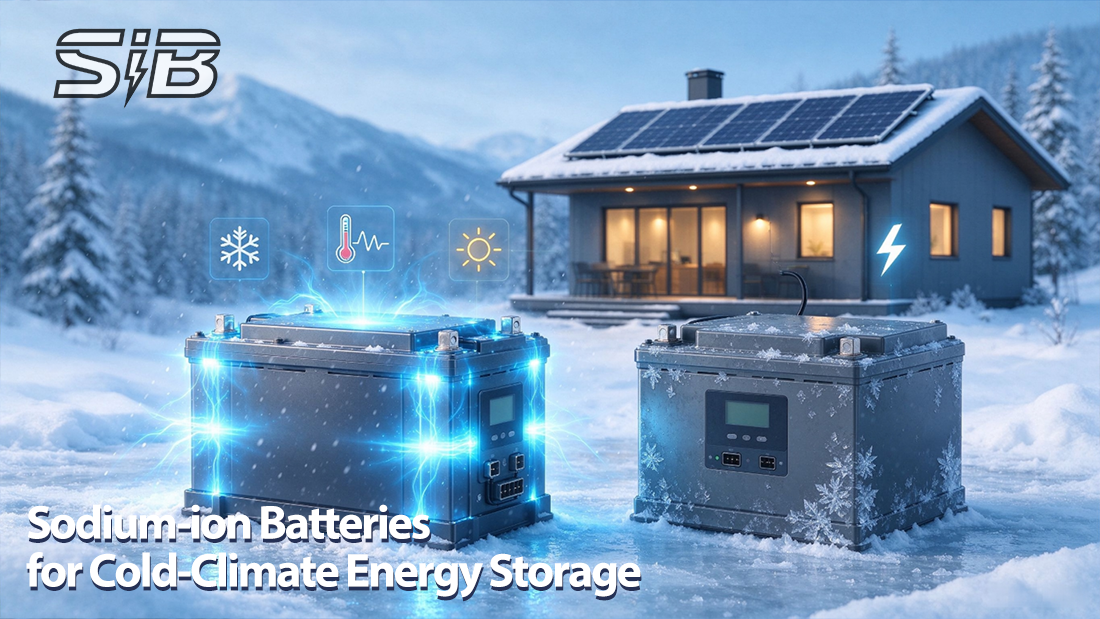
Low temperatures affect the electrochemical reactions inside rechargeable batteries. As the temperature falls, ion movement and charge-transfer processes generally become slower. The battery may deliver less usable energy, experience greater voltage drop under load and accept charging current more slowly.
These effects are important for any energy storage system installed in a cold climate.
A battery's rated capacity is usually measured under specified laboratory conditions, often near room temperature. When the same battery operates below 0°C, its actual deliverable capacity may decrease.
Cold temperatures can also increase internal resistance. Under load, this causes a larger voltage drop and may trigger low-voltage protection earlier than expected.
For example, a remote monitoring station may require a battery to power communication equipment continuously through a winter night. If the battery's available capacity and discharge power fall significantly in cold conditions, the system may need a larger capacity reserve or a different battery chemistry.
Charging in freezing conditions can be more challenging than discharging.
For conventional lithium-ion cells, charging at low temperatures can cause metallic lithium to deposit on the anode, a process known as lithium plating. This can permanently reduce capacity and, under certain conditions, increase safety risks.
Many LiFePO4 battery manufacturers therefore prohibit charging below 0°C unless the battery has an approved low-temperature charging strategy, such as internal heating or specific reduced-current controls.
Sodium-ion batteries also have low-temperature charging limitations. Their permitted charging range depends on electrode chemistry and electrolyte formulation. A battery that can discharge at -20°C or -40°C is not automatically capable of accepting a normal charging current at those temperatures.
Cold-climate energy storage systems may face several issues at the same time:
Reduced solar generation due to shorter daylight hours or snow cover
Higher energy consumption for heating and equipment operation
Lower battery capacity and power availability
Charging restrictions during freezing mornings
Temperature differences between the battery enclosure and surrounding air
Longer periods without maintenance access in remote locations
For these reasons, battery selection should be based on the entire operating environment, not just the minimum outdoor temperature.
Sodium-ion batteries use sodium ions as charge carriers. Their operating principle is similar to that of lithium-ion batteries: ions move between the positive and negative electrodes during charging and discharging.
Their potential advantage in cold environments comes from the characteristics of particular sodium-ion electrode and electrolyte systems. Some designs can maintain useful electrochemical activity at temperatures where certain lithium-ion products experience more pronounced performance losses.
The IEA identifies low-temperature performance as an important advantage of the latest sodium-ion battery generation, particularly when compared with LFP batteries. It reports that some advanced sodium-ion batteries can retain around 90% of nominal capacity at -40°C.IEA
This result is encouraging for applications such as outdoor energy storage, remote infrastructure and equipment operating in cold regions.
However, sodium-ion is a family of chemistries, not a single standardized cell design. Different cathodes, hard-carbon anodes, electrolytes and interface structures produce different results.
Low temperatures still create several electrochemical challenges.
Electrolyte conductivity decreases. As temperature falls, electrolyte viscosity generally increases and ionic conductivity can decline. This makes sodium-ion transport more difficult.
Ion diffusion slows down. Sodium ions move more slowly through electrode materials, which can increase polarization and limit charging or discharging performance.
Interfacial resistance increases. Changes in the electrode-electrolyte interface can make charge transfer less efficient. The solid electrolyte interphase (SEI) is particularly important because it influences ion transport and long-term stability.
Available capacity and power may decline. Higher resistance and slower reactions can reduce the energy and power available under a given operating condition.
These mechanisms are discussed in published reviews of low-temperature sodium-ion battery research. Wiley Online Library
No. This is one of the most important points for buyers to understand.
A temperature result reported for an advanced cell should not be applied to every commercial sodium-ion battery. Some products may support low-temperature discharge but have a higher minimum charging temperature. Others may require reduced current or preheating.
When evaluating a battery for cold-climate use, request separate specifications for:
Minimum charging temperature
Minimum discharging temperature
Maximum charging and discharging temperatures
Capacity retention at specified temperatures
Continuous and peak discharge current in cold conditions
Storage temperature range
BMS low-temperature protection thresholds
The manufacturer's datasheet and test report should take priority over general statements about sodium-ion technology.
LiFePO4 is widely used in residential energy storage, solar systems, RVs and industrial backup applications. It offers a mature supply chain, good cycle-life potential and a well-established safety record when correctly engineered.
Sodium-ion batteries are now being considered alongside LFP, especially where low-temperature performance is a priority.
The important point is that the comparison should be made at the product level. Neither chemistry has one temperature range that applies to every cell or battery pack.
Some advanced sodium-ion batteries can retain useful capacity at temperatures substantially below freezing. The IEA's reported figure of around 90% nominal capacity at -40°C illustrates the potential of the latest generation. However, it should not be treated as a standard performance guarantee for all sodium-ion products.IEA
LFP batteries can also discharge below 0°C, although their available capacity and power may decrease as temperature falls. The extent of the reduction depends on the cell, current, SOC and pack design.
A common limitation of conventional LFP batteries is low-temperature charging. For example, Rolls Battery states that its standard LFP products should not be charged at or below 0°C, while some models use internal heating to enable charging in colder environments.Technical Support & Warranty+1
Sodium-ion batteries may offer more flexible cold-weather operation, but charging restrictions still vary. A particular MICA POWER 12V sodium-ion battery specification, for example, lists a charging temperature of 0°C to 45°C and a discharging temperature of -30°C to 60°C. This illustrates why charging and discharging limits must be read separately.Mica Power Co., Ltd
Comparison factor | Sodium-ion batteries | LiFePO4 batteries |
|---|---|---|
Cold-weather discharge | Some advanced designs demonstrate strong low-temperature capability | Can discharge below 0°C, but available capacity and power may decline |
Low-temperature charging | Product-specific; some designs allow charging below 0°C, others do not | Many conventional products restrict charging below 0°C |
Heated battery options | Available in some product designs | Commonly available in selected LFP products |
Energy density | Generally lower than leading lithium-ion chemistries | Generally higher than many sodium-ion products |
Manufacturing maturity | Commercialization is expanding, but the supply chain is less mature | Established global production and supply chain |
Best selection approach | Verify exact cell and pack temperature data | Verify exact cell and pack temperature data |
This comparison is a technology-level overview, not a guarantee for a specific battery. The IEA identifies low-temperature performance as an advantage of advanced sodium-ion batteries, while noting that lower energy density remains a limitation compared with LFP. IEA+1
For a cold-region installation, I would compare actual capacity retention and charge-current limits at the project's expected minimum temperature—not simply choose the chemistry with the widest advertised operating range.
A reliable cold-climate battery system must be designed around two separate operating conditions: supplying energy in cold weather and safely accepting energy when charging becomes available.
Battery charging limits normally refer to the internal cell or battery temperature, not simply the temperature reported by an outdoor weather station.
A battery installed inside an insulated cabinet may remain warmer than the surrounding air. Conversely, a battery that has been exposed to freezing temperatures overnight may still be too cold to charge even after the outdoor temperature begins to rise.
Before charging, the BMS should confirm that the cell temperature is within the permitted range. If the battery is too cold, the system may need to delay charging, limit the current or activate an approved heating function.
A battery may be able to discharge at a lower temperature than it can charge. However, cold conditions can still reduce available power and cause voltage to drop more quickly under load.
This is particularly important for:
Inverters with high startup loads
Pumps and motors
Telecommunications equipment
Heating and control systems
Backup power installations with limited battery capacity
System designers should check continuous and peak discharge current at the minimum expected cell temperature.
Some battery packs include a low-temperature heating module. When the cell temperature falls below the approved charging threshold, the system can use an external or stored energy source to warm the battery before charging.
Preheating can improve winter charging availability, but it also introduces additional energy consumption and control requirements. The system designer should consider:
Heater power consumption
Warm-up time
Insulation quality
Temperature sensor placement
BMS control logic
Whether the heater draws energy from the battery or an external source
Heating should be designed and controlled by the battery manufacturer or system integrator. Direct, uncontrolled heating is not an appropriate substitute for a validated thermal-management design.
MICA POWER lists a 12V sodium-ion battery product with the following operating limits:
Parameter | Published product specification |
|---|---|
Nominal voltage | 12.4V |
Minimum capacity | 230Ah at 25°C, C10 |
Charging temperature | 0°C to 45°C |
Discharging temperature | -30°C to 60°C |
Recommended storage temperature | 20 ± 5°C |
These are the published specifications for the referenced model, not a universal specification for the MICA POWER sodium-ion range. The rated capacity is also specified at 25°C, so it should not be assumed to remain unchanged at -30°C.
This example highlights an important point: a battery can have a low minimum discharge temperature while still requiring a temperature above freezing for charging.
Cold-climate energy storage is not limited to one application. Sodium-ion batteries may be suitable for several systems where winter operation, remote installation or charging availability is important.

Solar systems in cold regions often experience seasonal changes in energy generation. Winter days are shorter, snow can cover panels, and energy consumption may increase due to heating and lighting.
A sodium-ion battery may be worth evaluating where the selected product has suitable low-temperature discharge performance.
However, solar charging must be coordinated with the battery's permitted charging temperature. A battery that can supply energy overnight at sub-zero temperatures may still need to be warmed before accepting solar charging current the following morning.
For an off-grid system, the designer should calculate:
Daily energy consumption in kWh
Expected winter solar generation
Required backup autonomy
Battery capacity at the design temperature
Maximum charging current
Inverter continuous and surge power
Heating energy, if required
The battery should be sized using the expected winter energy balance rather than summer operating data alone.
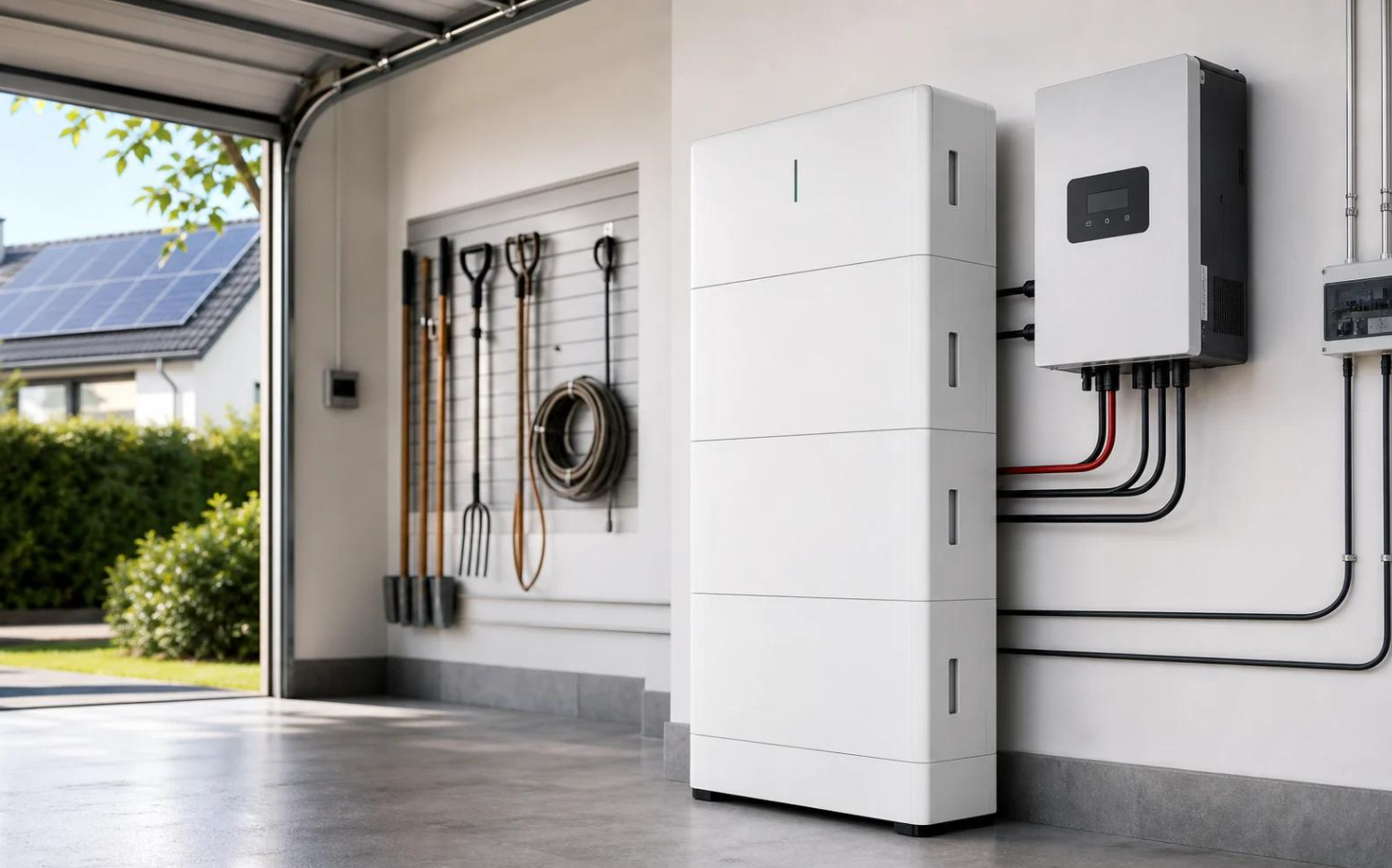
Backup power systems need to remain available when grid interruptions occur. In cold regions, these systems may be installed in garages, utility rooms, outdoor enclosures or remote buildings.
Sodium-ion batteries can be considered where the product's operating range and capacity meet the site's requirements.
For indoor installations, ambient temperatures may be easier to control. For outdoor cabinets, insulation, ventilation, moisture protection and temperature monitoring deserve more attention.
Telecommunications towers and remote monitoring stations may be located in areas with limited maintenance access. Battery reliability is therefore particularly important.
A suitable cold-weather battery should be able to support the expected standby duration, equipment load and recharge schedule. Low-temperature discharge performance is valuable, but the battery must also be able to recover its charge safely when power becomes available.
Industrial controllers, sensors, security systems and remote equipment can also benefit from batteries selected for the local climate.
In these applications, the design should account for both the minimum operating temperature and the peak power demand. A battery that maintains sufficient energy but cannot provide the required current may still be unsuitable.
Sodium-ion technology offers promising characteristics, but it is not a universal solution for cold-climate energy storage.
Many commercial sodium-ion batteries have lower gravimetric energy density than leading lithium-ion products. This means that a sodium-ion pack may require more space or weight to provide the same nominal energy.
For stationary storage, this may be manageable. For compact installations, mobile equipment or applications with strict weight limits, it can be a disadvantage.
Although advanced sodium-ion batteries may offer improved cold-weather capability, low-temperature charging remains a technical challenge. Electrolyte conductivity, ion desolvation, electrode diffusion and interfacial stability can all affect performance.Wiley Online Library+2
Buyers should not assume that a low-temperature discharge rating also applies to charging.
Sodium-ion commercialization is developing, but long-term field data and standardized product comparisons are less extensive than for established LFP systems.
Ask suppliers for test reports that specify the test temperature, discharge rate, SOC, voltage limits, cycle count and capacity-retention criteria.
If a battery requires preheating before charging, the heating system consumes energy and adds components. In an off-grid solar installation, that energy must be included in the system's winter energy budget.
The total cost of ownership should therefore include the battery, enclosure, heating system, BMS, inverter compatibility, maintenance and expected service life.
Sodium-ion chemistry does not eliminate the need for proper battery protection. A reliable pack should include suitable voltage, current and temperature monitoring, short-circuit protection, mechanical protection and an appropriate BMS.
The battery should also be installed according to its manufacturer's instructions and relevant local electrical and fire-safety requirements.
Choosing a supplier is as important as choosing a battery chemistry. For cold-climate projects, I recommend evaluating the supplier's product documentation, engineering capability and ability to support the complete battery system.
Ask for the permitted charging, discharging and storage temperatures. Confirm whether the values refer to cell temperature, module temperature or ambient temperature.
A supplier should be able to explain any difference between the temperature at which a battery can operate and the temperature at which it can deliver rated power.
A useful test report should include:
Test temperature and stabilization time
Initial SOC
Charging and discharging current
Cut-off voltage
Capacity retention
Discharge energy and power
Cell temperature during testing
Number of test cycles, where applicable
Avoid relying on a single temperature figure without the test conditions behind it.
Confirm whether the BMS monitors cell temperature, blocks charging below the permitted threshold and supports current limitation.
If the application needs winter charging, ask whether the battery includes a heating module and how its operation is controlled.
For OEM and energy storage projects, the battery may need a specific voltage, capacity, enclosure, connector, communication protocol or mounting structure.
A capable supplier should be able to review the application requirements before recommending a configuration.
Evaluation item | What to verify |
|---|---|
Battery chemistry | Exact sodium-ion cell chemistry and model |
Temperature range | Separate charging, discharging and storage limits |
Cold-weather data | Capacity and power test results at target temperatures |
BMS | Low-temperature charging protection and temperature monitoring |
Heating option | Availability, control method and energy consumption |
Electrical compatibility | Voltage, current, charger and inverter requirements |
Mechanical design | Dimensions, terminals, enclosure and installation method |
Certifications | Relevant product and transport certifications |
Quality management | Production controls, inspection and traceability |
After-sales support | Technical documentation, warranty and long-term supply |
MICA POWER was established in 2013 and specializes in the R&D, production and sales of energy storage batteries and systems, including sodium-ion batteries and LiFePO4 battery packs. The company's published information also describes a core team with more than 20 years of lithium battery industry experience.Mica Power Co., Ltd.
Our sodium-ion product range includes 12V battery packs and energy storage products. Some listed models offer customization options such as battery displays, Bluetooth monitoring, enclosure dimensions, module structures and low-temperature heating modules. These options are product-dependent and should be confirmed for each project.Mica Power Co., Ltd.+1
For a cold-climate project, we recommend sharing the minimum ambient temperature, charging source, daily energy consumption, peak load and required backup duration. This information helps us assess whether a standard battery configuration is suitable or whether a customized pack and thermal-management solution should be considered.
Explore our sodium-ion battery products or learn more about MICA POWER.
Sodium-ion batteries offer promising advantages for cold-climate energy storage, particularly where low-temperature discharge performance and alternative battery supply chains are important. The IEA's reported results for advanced sodium-ion products demonstrate how far the technology has progressed.
However, the practical choice depends on the exact product. Charging temperature, discharge capability, available capacity, BMS protection and thermal management must all be evaluated together. Sodium-ion is not automatically suitable for charging at -40°C, and a low-temperature discharge rating should never be treated as a charging specification.
For solar energy storage, remote backup power and industrial applications, the best solution is the battery system that meets the site's real winter operating conditions.
At MICA POWER, we encourage customers to evaluate battery chemistry alongside product-level test data and system requirements. This approach helps avoid unrealistic temperature assumptions and supports more reliable energy storage design.
For sodium-ion battery inquiries and customized energy storage projects, visit https://www.sibbattery.com/ or contact info@sibbattery.com.
Some advanced sodium-ion batteries demonstrate better low-temperature discharge performance than conventional LiFePO4 batteries. However, the actual difference depends on the cell design, charging limits, discharge current and battery pack. Always compare product-specific test data.
Not all sodium-ion batteries can. Some specially designed products support low-temperature charging, while others require the cell temperature to reach 0°C or higher. Check the manufacturer's charging specifications and BMS settings before use.
Some advanced sodium-ion products have demonstrated discharge operation at -40°C. However, this is not a universal rating. For example, a MICA POWER 12V sodium-ion battery model lists a discharge temperature range of -30°C to 60°C. The exact model datasheet should always be used for system design.
They can be suitable when their capacity, discharge power, charging temperature and BMS functions meet the site's winter requirements. Designers should also consider reduced solar generation, backup autonomy and any energy needed for battery preheating.


