
- All
- Product Name
- Product Keyword
- Product Model
- Product Summary
- Product Description
- Multi Field Search


Views: 0 Author: Site Editor Publish Time: 2026-10-27 Origin: Site


Sodium-Ion Battery Low-Temperature Performance
When we talk with customers about sodium-ion batteries, one question comes up repeatedly:
How well does a sodium-ion battery actually perform in cold weather?
It is an important question because temperature can change almost every aspect of battery behavior. A battery that performs well at 25°C may deliver considerably less power or capacity when the temperature drops below 0°C.
Sodium-ion batteries have attracted particular attention because their low-temperature performance can be better than that of conventional lithium-ion batteries, especially some LFP-based systems. The International Energy Agency (IEA) reports that the latest generation of sodium-ion batteries can retain around 90% of nominal capacity at temperatures as low as -40°C in certain advanced designs. However, this figure should not be interpreted as a universal specification for every sodium-ion battery on the market. IEA
From our perspective at MICA POWER, the more useful question is not simply whether sodium-ion batteries work in cold weather. They do.
The real engineering question is:
How much capacity, power, charging capability and cycle life can a particular sodium-ion battery maintain at a particular temperature?
That depends on the cell chemistry, electrode materials, electrolyte, battery design, BMS, charging strategy and operating conditions.
In this article, I will explain the science behind sodium-ion battery low-temperature performance, examine what happens below 0°C, compare different temperature ranges, discuss charging and discharge behavior, and explain where sodium-ion technology can provide a practical advantage.

Yes, sodium-ion batteries can perform very well at low temperatures, but their performance still decreases as temperature falls.
This distinction is important.
Sodium-ion technology is not immune to cold-temperature effects. Like other rechargeable batteries, sodium-ion batteries experience slower electrochemical kinetics, increased internal resistance and reduced ion transport at low temperatures.
However, research and commercial development indicate that sodium-ion batteries can maintain useful performance in temperatures where conventional lithium-ion batteries experience much greater degradation.
The IEA reports that advanced sodium-ion batteries can retain approximately 90% of nominal capacity at -40°C, and can operate at temperatures up to approximately 70°C, although these figures apply to specific newer-generation technologies rather than all sodium-ion products. IEA
Recent experimental characterization of early commercial sodium-ion cells also provides an important reality check. A 2026 study found that tested sodium-ion chemistries retained approximately 51–62% of their 25°C discharge capacity at -40°C under the study's specified test protocol. IDEAS/RePEc
These two figures are not contradictory.
They demonstrate why we should always ask:
Which sodium-ion chemistry? Which cell? Which test protocol? Which discharge rate? Which definition of capacity retention?
For battery engineering, test conditions matter as much as headline numbers.
Temperature affects a battery through several interconnected mechanisms.
When the temperature decreases, the movement of sodium ions becomes more difficult. The electrolyte becomes more viscous, ionic conductivity decreases, charge-transfer reactions become slower, and diffusion within electrode materials becomes more limited.
Research reviews identify several major low-temperature limitations:
Increased electrolyte viscosity
Reduced ionic conductivity
Slower Na⁺ diffusion
Increased charge-transfer resistance
Changes in the solid-electrolyte interphase (SEI)
Greater electrode/electrolyte interfacial resistance
Possible structural changes in electrode materials
Reduced usable capacity
Reduced power capability
Increased charging difficulty
A 2024 review in Carbon Energy identifies increased electrolyte viscosity, abnormal SEI growth and poor electrode/current-collector contact among the mechanisms that hinder sodium-ion transport and degrade low-temperature performance. Wiley Online Library
A 2024 review in Advanced Energy Materials similarly concludes that sluggish electrochemical kinetics, unstable electrode/electrolyte interfaces and slow sodium-ion diffusion are central causes of performance deterioration at low temperatures. DOI
In simple terms:
Cold temperatures make it harder for sodium ions to move through the battery and for the electrochemical reactions to proceed efficiently.
One common misunderstanding is that a battery permanently loses all of its capacity when the temperature falls.
That is not necessarily what happens.
At low temperature, some of the apparent capacity loss is related to reduced electrochemical accessibility during the test.
For example, a battery may have a certain amount of chemical energy stored internally, but the low temperature can make ion transport and charge-transfer reactions too slow for the battery to release all of that energy at the specified discharge rate.
As temperature rises again, some of the temporarily inaccessible capacity can become available.
This is why battery specifications often distinguish between:
Nominal capacity
and
Available capacity at a specific temperature and discharge rate.
For customers designing an energy-storage system, I recommend evaluating the second value rather than relying exclusively on the nominal Ah rating.
The following table provides a practical framework rather than a universal product specification.
| Temperture | Typical Battery Behavior | Engineering Consideration |
20–25°C | Near reference conditions for many battery tests | Best baseline for capacity and power comparison |
10–20°C | Generally modest performance reduction | Usually manageable for normal applications |
0–10°C | Increasing resistance and slower kinetics | Capacity and power may begin to decline |
-10–0°C | More noticeable reduction in ion transport | Charging strategy becomes increasingly important |
-20 to -10°C | Significant low-temperature effects | Cell chemistry and electrolyte become critical |
-30 to -20°C | Strong polarization and reduced available capacity | Specialized low-temperature design is recommended |
-40 to -30°C | Extreme operating conditions | Only specially engineered battery systems should be considered |
These ranges should not be interpreted as guaranteed operating limits for every sodium-ion battery.
Published research confirms that sodium-ion batteries experience substantial degradation as temperature falls, while advanced commercial technologies can retain meaningful performance at extremely low temperatures. Wiley Online Library
There is a scientific reason sodium-ion batteries have attracted attention for cold-temperature applications.
Although Na⁺ has a larger bare ionic radius than Li⁺, its behavior in an electrolyte is not determined by ionic radius alone. Recent research highlights factors including solvation behavior, desolvation energy and the effective Stokes radius.
A 2026 review reports that Na⁺ can have a smaller Stokes radius and lower desolvation energy barrier than Li⁺, giving sodium-ion systems potential thermodynamic and kinetic advantages at low temperature. PubMed Central (PMC)
This helps explain why sodium-ion batteries can perform differently from lithium-ion batteries under cold conditions.
But there is an important qualification:
Better low-temperature behavior does not mean zero temperature-related degradation.
The electrolyte and electrode system still determine practical performance.
The electrolyte is one of the most important components in a low-temperature sodium-ion battery.
Inside a rechargeable battery, sodium ions need to travel through the electrolyte between the electrodes.
When temperature falls:
Electrolyte viscosity increases.
Ion mobility decreases.
Ionic conductivity can decline.
Desolvation becomes more difficult.
Charge-transfer resistance increases.
At sufficiently low temperatures, the electrolyte may approach its freezing or precipitation limits depending on its formulation.
A recent review published in EES Batteries explains that conventional carbonate-based electrolyte systems can face freezing and salt-precipitation problems at sufficiently low temperatures. 皇家化学学会出版物
This is why simply changing the active electrode material is not enough.
For genuinely low-temperature battery design, we need to consider the entire electrochemical system.
At MICA POWER, this is particularly relevant when evaluating batteries intended for outdoor or cold-climate applications.
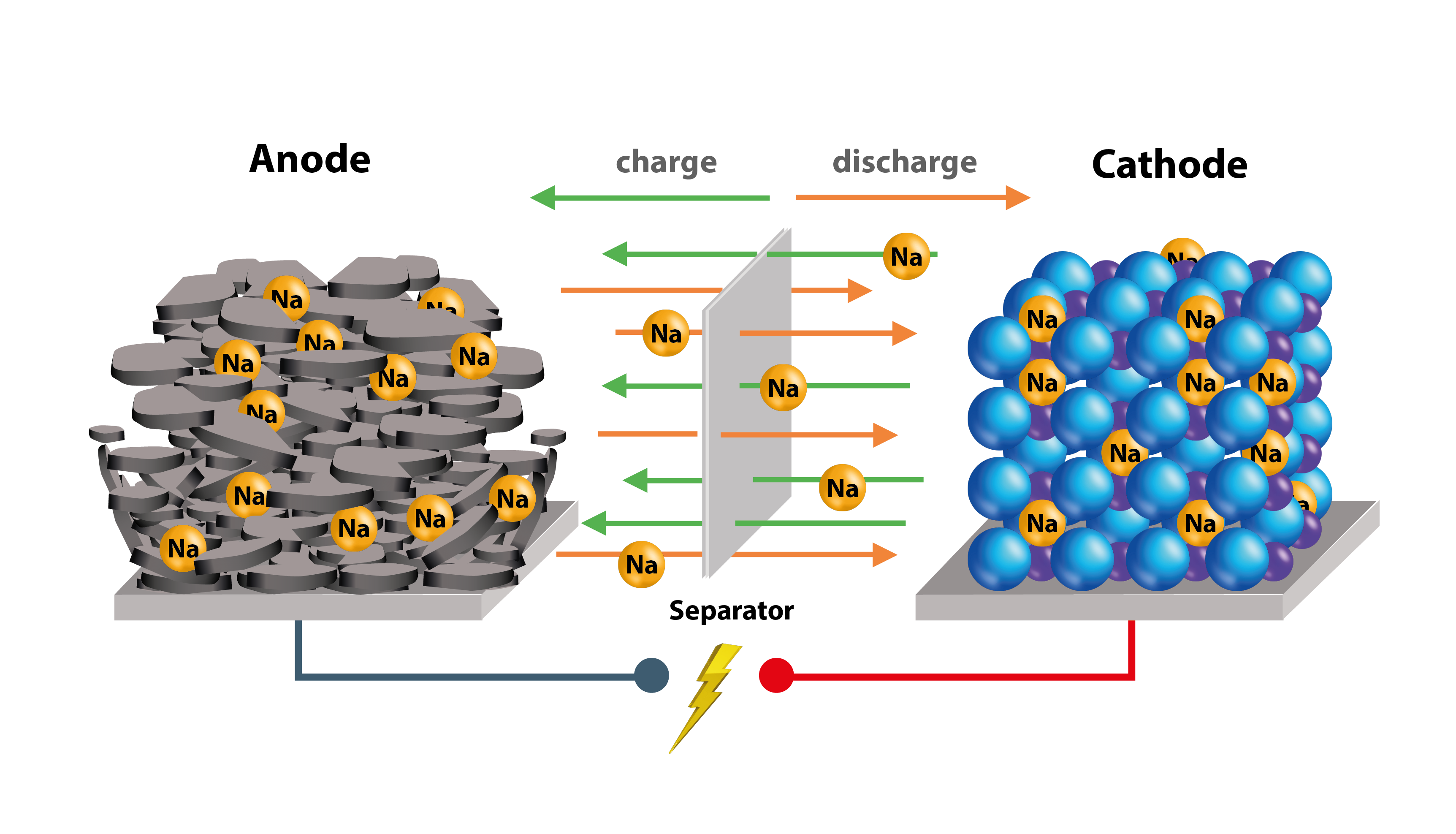
The second major factor is the electrode.
Sodium ions must move into and out of the electrode structure during charging and discharging.
At low temperatures, solid-state diffusion becomes slower.
This can lead to:
Increased polarization
Lower discharge voltage
Reduced capacity
Reduced power output
Greater internal resistance
Reduced cycle stability
Research into low-temperature sodium-ion batteries has therefore focused heavily on electrode structures that can maintain sodium-ion transport under cold conditions.
Studies have investigated carbon-based anodes, titanium-based materials, NASICON-type materials, layered oxides and polyanionic cathodes, among other approaches. PubMed
For example, laboratory research has demonstrated sodium-ion electrode systems retaining high capacity after hundreds of cycles at sub-zero temperatures. These results are valuable for understanding materials science, but they should not automatically be transferred to a commercial battery pack because laboratory cells and commercial systems can have very different designs and test conditions. PubMed Central (PMC)
That distinction is important for credible battery content.
Capacity is only half of the story.
Power capability can also decrease significantly.
Imagine a battery rated at 100 Ah at room temperature.
The battery may still contain substantial electrochemical energy at -20°C, but if internal resistance has increased substantially, the battery may be unable to deliver the same current without a larger voltage drop.
This is known as polarization.
The result can be:
Lower terminal voltage under load
Reduced peak discharge current
Reduced usable power
Earlier low-voltage protection
Greater heat generation under high loads
Recent reviews identify increased charge-transfer resistance and slower ion transport as key causes of this behavior. 皇家化学学会出版物
Therefore, when designing a sodium-ion battery for cold environments, we should evaluate both:
Energy performance and power performance.
This is one of the most important practical questions.
You should never assume that a sodium-ion battery can be charged at every temperature simply because it can discharge at that temperature.
Charging and discharging are different electrochemical processes.
At low temperatures, charging can become more difficult because ion transport and interfacial reactions slow down.
Depending on the cell chemistry and charging conditions, undesirable deposition or side reactions can occur.
Recent research specifically identifies increased sodium-plating risk as one of the low-temperature challenges that needs to be considered in sodium-ion battery design. The Advanced Portfolio
Therefore, a low-temperature battery specification should ideally identify:
Minimum charging temperature
Minimum discharge temperature
Maximum charging current at low temperature
Maximum discharge current at low temperature
Preheating requirements
BMS temperature protection
Recommended storage temperature
These specifications are much more useful than simply advertising a very wide temperature range.
The difference deserves its own section.
During discharge, the battery delivers energy to an external load.
At low temperatures, the major problems are generally:
Reduced ion mobility
Increased resistance
Increased polarization
Lower available capacity
Reduced power capability
A battery may still operate, but the usable energy and power can be lower than at room temperature.
Charging requires sodium ions to move back into the appropriate electrode structure.
If charging is performed too aggressively at low temperature, undesirable electrochemical reactions can occur.
For this reason, the minimum charging temperature can be more restrictive than the minimum discharge temperature.
This is a critical consideration when designing a battery for winter solar storage.
A system might discharge successfully at -20°C overnight but still require temperature management before accepting a high charging current from the solar array the next morning.
Sodium-ion batteries are often discussed as an alternative to lithium-ion batteries specifically because of their cold-weather performance.
The IEA states that sodium-ion batteries have significantly better low-temperature performance than lithium-ion batteries, particularly LFP chemistry. IEA
The difference becomes particularly interesting below 0°C.
However, I would avoid saying:
“Sodium-ion is always better than lithium-ion in cold weather.”
That statement is too broad.
Lithium-ion technology includes multiple chemistries, electrode designs and thermal-management systems. Modern lithium-ion battery packs can also be engineered for cold environments using insulation, heating and sophisticated BMS control.
The more accurate statement is:
Advanced sodium-ion chemistry has demonstrated strong inherent low-temperature performance and can be particularly attractive where cold-weather operation is a major design requirement.
Lead-acid batteries also experience temperature-dependent performance.
Cold temperatures increase the internal resistance of lead-acid batteries and reduce their available capacity, making winter operation particularly important for applications such as vehicle starting, outdoor equipment and backup power.
This creates an interesting opportunity for sodium-ion technology.
Compared with traditional lead-acid systems, a well-designed sodium-ion battery can provide:
Lower weight for a given amount of stored energy
Higher usable energy in suitable applications
Lower maintenance
Better charging characteristics
Strong cold-temperature capability
However, lead-acid has one major advantage:
It is extremely mature.
Lead-acid batteries have established manufacturing, distribution, installation and recycling networks worldwide.
Therefore, I see sodium-ion not as an automatic replacement for every lead-acid battery, but as a technically attractive alternative for applications where cold-temperature performance and cycling matter.
The phrase “-40°C sodium-ion battery” receives a lot of attention online, but this subject needs careful interpretation.
The IEA reports that the latest generation of sodium-ion batteries can retain around 90% of nominal capacity at -40°C. IEA
At the same time, a 2026 experimental study of early-generation commercial sodium-ion cells found that tested cells retained approximately 51–62% of their 25°C discharge capacity at -40°C, under its specified testing protocol. IDEAS/RePEc
Why are the numbers different?
Because battery performance depends on:
Cell chemistry
Electrode formulation
Electrolyte
Cell format
State of charge
Discharge rate
Test duration
Temperature stabilization
Voltage limits
Capacity definition
Battery management system
This is exactly why we should avoid using one impressive laboratory or manufacturer number to represent the entire sodium-ion industry.
For customers evaluating MICA POWER battery solutions, we recommend looking at the actual product datasheet and application-specific test results rather than relying on a generic sodium-ion specification.
Researchers and manufacturers are working on several approaches simultaneously.
Engineers can modify electrolyte composition to improve ionic conductivity and reduce freezing or precipitation problems.
This is one of the most direct ways to improve low-temperature performance.
Increasing effective ion-transport pathways can reduce diffusion limitations.
Researchers have investigated nanoscale structures, conductive networks and optimized particle architectures for this purpose. PubMed
The electrode/electrolyte interface becomes increasingly important as temperature decreases.
Researchers are studying how to create stable interfacial layers with lower resistance.
A good battery management system can monitor:
Cell temperature
Pack temperature
Voltage
Current
SOC
Charging conditions
The BMS can then limit charging or discharge current when necessary.
For particularly demanding applications, thermal management can help keep cells within their preferred operating window.
Possible strategies include:
Insulation
Heating elements
Thermal sensors
Controlled charging
Enclosures designed for harsh environments
The objective is not necessarily to make the battery “immune” to cold.
It is to manage the battery's operating environment so the electrochemical system stays within an acceptable performance and safety window.
This is one of the applications I consider particularly promising.
Remote solar systems may be exposed to temperatures well below 0°C, especially during winter.
A battery with strong low-temperature performance can reduce dependence on external heating and help maintain energy availability.
Potential applications include:
Remote solar stations
Off-grid cabins
Rural energy systems
Telecommunications
Monitoring equipment
Industrial backup systems
RV and marine batteries can face large temperature variations.
Weight, maintenance and cold-start behavior can all matter.
A sodium-ion battery can be attractive where the system needs to operate outdoors and where conventional lead-acid batteries create weight or maintenance challenges.
Equipment installed in cold regions may need reliable energy storage without frequent maintenance visits.
Examples include:
Remote monitoring stations
Security equipment
Communication systems
Industrial control systems
Remote sensors
Sodium-ion technology is also being evaluated for automotive applications.
The IEA notes that sodium-ion batteries can be particularly useful in cold climates and could be deployed in hybrid battery configurations to limit cold-weather range losses. IEA
However, automotive requirements are extremely demanding, so application-specific engineering and certification remain essential.
| Factor | Low-temperature sodium-ion performance |
Capacity retention | Can remain relatively strong in advanced designs |
Discharge performance | Generally usable below 0°C, with performance decreasing as temperature falls |
Charging | Requires careful temperature and current management |
Internal resistance | Increases as temperature decreases |
Ion transport | Slows at low temperatures |
Electrolyte behavior | Strongly dependent on formulation |
Cycle life | Can decline under severe cold and aggressive operation |
-20°C operation | Technically feasible for appropriately designed systems |
-40°C operation | Possible for specialized/advanced designs, but specifications vary significantly |
Thermal management | May be needed for demanding applications |
Main advantage | Strong cold-weather potential compared with several competing chemistries |
Main limitation | Low-temperature performance is still chemistry- and design-dependent |
A common mistake is to focus only on whether a battery can operate at a certain temperature.
Operating is not the same as operating indefinitely without degradation.
Repeated cycling under harsh conditions can accelerate degradation.
At low temperatures, increased polarization and interfacial instability can place additional stress on the electrochemical system. Reviews of sodium-ion batteries consistently identify low-temperature cycle stability as an ongoing research challenge. Wiley Online Library
For a commercial system, I would therefore evaluate three separate questions:
Can the battery discharge at the target temperature?
Can it charge safely at the target temperature?
How does repeated cycling at that temperature affect lifetime?
A battery that passes the first test may not necessarily pass the other two.
At MICA POWER, we believe battery performance should always be discussed in the context of the application.
We do not consider “works at -40°C” to be a sufficient engineering specification by itself.
When we develop or evaluate a sodium-ion battery solution, we look at the complete system:
Cell chemistry
Cell specifications
Battery capacity
Continuous discharge current
Peak discharge current
Charging current
BMS protection
Operating temperature
Storage temperature
Mechanical design
Connector configuration
Communication requirements
Application environment
This is especially important for OEM and ODM projects.
A battery intended for an indoor backup system has very different requirements from a battery installed outdoors in a sub-zero climate.
MICA POWER develops and supplies sodium-ion battery products for applications including energy storage and replacement applications. Our product portfolio includes 12V/12.4V/48V sodium-ion battery solutions designed for applications such as solar systems, marine equipment and golf carts.
For customers considering sodium-ion as an alternative to lithium-ion or lead-acid, we recommend starting with the actual operating conditions rather than selecting a battery solely by nominal voltage and capacity.
Before purchasing or specifying a sodium-ion battery for a cold environment, I recommend checking at least these ten parameters.
Do not confuse storage temperature with operating temperature.
This is especially important for solar and outdoor systems.
Ask for capacity data at the actual temperature you expect.
Capacity at 0.2C and capacity at 2C can be very different.
The BMS should have appropriate temperature monitoring and protection.
“Sodium-ion” describes a battery family, not one single cell chemistry.
Electrolyte behavior is fundamental to low-temperature performance.
Determine whether heating or insulation is required.
Ask whether cycle-life data were measured at room temperature or at the intended operating temperature.
Check inverter, charger, alternator, controller and communication compatibility before replacing an existing battery.
If I had to summarize this subject for a customer in five points, I would say:
First, sodium-ion batteries can offer strong low-temperature performance and are attracting significant attention for cold-climate energy storage.
Second, low temperature still reduces sodium-ion battery performance. Increased resistance, slower ion diffusion, electrolyte limitations and interfacial effects remain important technical challenges.
Third, the often-cited -40°C performance figures are technology-specific. The IEA reports approximately 90% nominal-capacity retention for the latest generation in certain designs, while independent testing of early commercial cells has shown substantially lower retention under some test conditions. IEA
Fourth, low-temperature charging deserves particular attention. A battery's discharge capability at -20°C does not automatically mean that it can accept the same charging current at -20°C.
Finally, I believe sodium-ion's strongest opportunity is not to replace every other battery chemistry. It is to provide a technically compelling option where cold-temperature performance, material availability, cycling capability and system economics are important.
The operating temperature depends on the specific cell and battery design. Some advanced sodium-ion batteries have demonstrated operation at extremely low temperatures, and the IEA reports that the latest generation can operate at temperatures as low as -40°C. IEA
Yes, some advanced sodium-ion battery technologies are designed to operate at -40°C. However, the exact capacity, power and charging capability at -40°C varies considerably between products. Published commercial-cell testing has also shown capacity retention well below room-temperature values at -40°C. IDEAS/RePEc
Yes. Sodium-ion batteries also experience capacity reduction at low temperatures. The severity depends on the chemistry, electrolyte, electrode design, discharge rate and temperature.
It depends on the battery's specifications. Low-temperature charging requires careful control because electrochemical kinetics and interfacial behavior change substantially in cold conditions. Always follow the manufacturer's specified charging-temperature and current limits.
Sodium-ion chemistry can offer favorable ion transport and interfacial characteristics at low temperatures, and advanced sodium-ion cells have demonstrated strong cold-weather performance. The IEA specifically identifies low-temperature operation as an important advantage of sodium-ion technology. IEA
Advanced sodium-ion batteries can have an advantage over LFP lithium-ion batteries at very low temperatures. The IEA specifically reports significantly better low-temperature performance for sodium-ion compared with LFP. However, the actual result depends on the specific cells and thermal-management systems being compared. IEA
Sodium-ion batteries can offer advantages in cold-weather applications, particularly in terms of usable energy, weight, maintenance and cycling. However, lead-acid remains a mature and widely available technology, so the correct choice depends on the application and operating conditions.
Cold temperatures can increase polarization, slow electrochemical kinetics and contribute to degradation if the battery is repeatedly operated outside its recommended temperature range. Proper BMS control and adherence to charging and discharge limits are important.
The main challenges are slower sodium-ion transport, increased electrolyte viscosity, higher interfacial resistance, slower charge-transfer kinetics and instability of electrode/electrolyte interfaces. Wiley Online Library
Yes. Cold-climate solar storage is one of the applications where sodium-ion technology has strong potential. The system should nevertheless be designed around the actual minimum temperature, charging conditions, required power and expected cycling profile.
Sodium-ion battery low-temperature performance is becoming one of the technology's most important differentiating characteristics.
The research is clear that cold temperatures still create challenges. Electrolyte transport slows, sodium-ion diffusion becomes more difficult, charge-transfer resistance rises and electrode/electrolyte interfaces can become less stable. Wiley Online Library
At the same time, commercial development is moving rapidly.
The IEA now identifies sodium-ion as an emerging battery technology entering the scale-up phase and highlights its particularly strong performance in cold climates. IEA
For us at MICA POWER, this is where sodium-ion becomes especially interesting.
We do not see low-temperature performance as simply a marketing number such as “-40°C.”
We see it as a combination of capacity retention, power capability, charging behavior, cycle life, BMS protection and thermal management.
That is the level at which a battery should ultimately be evaluated.
If your application operates in a cold environment, the right approach is to provide the battery manufacturer with the expected temperature range, required capacity, continuous and peak load, charging source and cycling pattern. From there, the appropriate sodium-ion cell and battery architecture can be evaluated for the actual operating conditions.
In other words, the best cold-weather battery is not necessarily the one with the lowest advertised temperature. It is the one that can reliably deliver the required energy and power throughout its real operating environment.


