
- All
- Product Name
- Product Keyword
- Product Model
- Product Summary
- Product Description
- Multi Field Search


Views: 0 Author: Site Editor Publish Time: 2026-11-18 Origin: Site


When choosing a starter battery for a car, motorcycle, ATV, UTV, or boat, buyers often compare voltage and amp-hour capacity first. However, these two specifications do not tell the whole story. For engine-starting applications, the battery’s ability to deliver high current while maintaining sufficient voltage is equally important.
This is why Cold Cranking Amps (CCA), peak discharge current, internal resistance, and low-temperature performance deserve particular attention when comparing a sodium-ion starter battery with a conventional lead-acid battery.
Sodium-ion technology is attracting interest in the automotive and powersports battery markets. It offers an alternative battery chemistry with potential advantages in material availability, weight, and low-temperature discharge performance. Purpose-designed sodium-ion starter batteries are now available in different capacities, including compact 12V 4.5Ah, 7Ah, 8Ah, and 9Ah models, as well as higher-capacity 12V 40Ah 100Ah automotive starting batteries.
We believe that selecting a starter battery should begin with the vehicle’s actual starting requirements—not simply its Ah rating. In this guide, we compare sodium-ion and lead-acid starter batteries and explain what distributors, OEM buyers, and replacement-battery customers should check before purchasing.
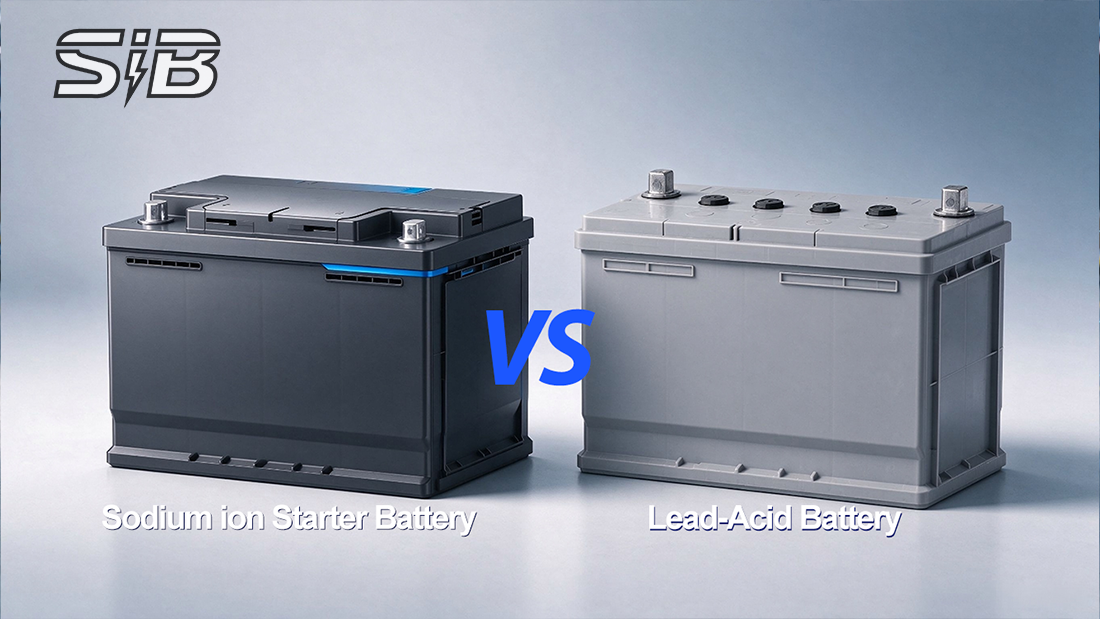
A sodium-ion starter battery is a rechargeable battery designed to supply the short, high-current output required to start an internal combustion engine. Instead of using lead-based electrodes and sulfuric acid electrolyte, it uses sodium-ion electrochemistry.
During discharge, sodium ions move between the battery’s electrodes, releasing electrical energy to the external circuit. The battery supplies power to the starter motor and, depending on the vehicle, supports other low-voltage electrical loads.
A starter battery has different priorities from a deep-cycle energy storage battery. It must provide a strong current pulse, maintain sufficient terminal voltage, and recover through the vehicle’s charging system.
Purpose-designed 12V sodium-ion starter batteries can be evaluated for:
Passenger cars and selected light commercial vehicles.
Motorcycles and scooters.
ATVs and UTVs.
Snowmobiles and powersports equipment.
Boats and personal watercraft.
Generators and small-engine equipment.
The correct model depends on engine size, starter-motor current, vehicle charging voltage, installation dimensions, and environmental conditions.
Lead-acid batteries remain widely used because their technology is mature, their cost is competitive, and automotive charging systems have been designed around them for decades.
Sodium-ion batteries offer a different set of characteristics. Their potential advantages include alternative material sourcing, compact high-power designs, and promising low-temperature discharge performance in certain commercial products.
However, sodium-ion batteries are not automatically direct replacements for lead-acid batteries. Their charging voltage, operating-voltage range, protection settings, and current ratings may differ.
| Comparison factor | Sodium-ion starter battery | Lead-acid starter battery |
|---|---|---|
| Battery chemistry | Sodium-based electrodes | Lead-based electrodes and sulfuric acid electrolyte |
| Market maturity | Emerging automotive starter application | Mature and widely established |
| Starting current | Depends on cell design and pack configuration | Established high-current starting technology |
| CCA measurement | Requires a clearly defined and validated test method | Established automotive CCA standards |
| Low-temperature discharge | Some products offer broad discharge-temperature ranges | Starting performance generally declines in cold conditions |
| Weight | Can be lighter than comparable lead-acid designs | Generally heavier |
| Charging requirements | Must follow the sodium-ion pack’s specified voltage and current limits | Broad compatibility with conventional vehicle charging systems |
| Maintenance | No electrolyte maintenance in sealed pack designs | Depends on battery type; flooded batteries require more maintenance |
| Recycling | Developing recycling infrastructure | Highly established lead-acid recycling infrastructure |
The most useful comparison is between two complete batteries with equivalent application requirements and verified test data. General chemistry descriptions alone cannot establish which product will start a particular engine more reliably.
CCA stands for Cold Cranking Amps. It describes a starter battery’s ability to deliver a specified current at a low temperature while maintaining a minimum terminal voltage for a defined period.
For buyers in cold regions, CCA is one of the most important specifications when selecting an automotive starter battery.
Under the SAE J537 automotive battery test procedure, the conventional CCA test involves cooling a fully charged battery to -18°C (0°F), then discharging it at the rated current for 30 seconds. The battery must maintain a terminal voltage of at least 7.2V at the end of the test.
European EN 50342 procedures use a different cranking-current test definition. For example, EN 50342-1:2015 defines cranking current at -18°C for 10 seconds, with a minimum voltage of 7.5V.
This distinction matters because ratings obtained using different test standards and conditions are not automatically interchangeable.
| Test reference | Test temperature | Discharge duration | Minimum voltage |
|---|---|---|---|
| SAE J537 CCA procedure | -18°C | 30 seconds | 7.2V |
| EN 50342-1:2015 cranking-current definition | -18°C | 10 seconds | 7.5V |
These are examples of two different test definitions. Always identify the standard used when comparing published starting-current ratings.
A manufacturer should provide the test method, battery temperature, discharge current, test duration, voltage limit, and sample information supporting its CCA claim.
Amp-hour capacity (Ah) measures the amount of electrical charge a battery can deliver under specified test conditions. CCA measures its ability to supply high current during a cold-start test.
For example, two 12V 40Ah batteries may have the same nominal capacity but very different starting performance.
One may be designed with cells and connections optimized for high-current output, while the other may be designed primarily for longer-duration discharge.
Therefore, a 40Ah rating does not automatically mean 400A, 600A, or 800A of starting capability.
For automotive buyers, Ah and CCA should be evaluated separately.
CCA is important, but it is not the only specification that determines whether an engine starts successfully.
When the starter motor operates, the battery experiences a sudden high-current load. Its terminal voltage falls under load because of internal resistance and electrochemical polarization.
If voltage falls below the level required by the starter motor, ignition system, or vehicle electronics, the engine may crank slowly or fail to start.
Three parameters deserve attention.
Peak discharge current indicates the maximum current a battery can provide for a specified short period.
However, the current figure must always be accompanied by its pulse duration and test conditions. A 500A pulse for one second is not equivalent to a 500A discharge sustained for ten or thirty seconds.
Lower internal resistance generally helps reduce voltage drop during high-current discharge.
It is affected by cell design, temperature, state of charge, cell ageing, busbars, terminals, and connection quality.
The battery management system must tolerate the current required by the starter motor.
If the protection threshold is too low or the response is not suitable for engine-starting pulses, the battery may disconnect during cranking.
For this reason, buyers should request both cell-level and complete-pack performance information.
Low-temperature performance is one reason buyers are evaluating sodium-ion starter batteries for outdoor vehicles and equipment.
Cold conditions increase engine oil viscosity and can make the engine harder to turn. At the same time, battery electrochemical reactions and ion transport become slower, which can increase internal resistance and reduce available power.
Some sodium-ion cell designs are engineered to maintain useful discharge performance at low temperatures. However, the actual performance depends on the cell chemistry, pack design, state of charge, discharge current, and temperature.
MICA POWER’s published starter-battery product information includes the following discharge-temperature ranges:
| MICA POWER product | Published discharge temperature | Published charging temperature |
|---|---|---|
| 12V 4.5Ah sodium-ion battery | -30°C to 60°C | 0°C to 45°C |
| 12V 7Ah sodium-ion battery | -30°C to 60°C | 0°C to 45°C |
| 12V 8Ah sodium-ion battery | -40°C to 60°C | -10°C to 45°C |
| 12V 9Ah sodium-ion battery | -30°C to 60°C | 0°C to 45°C |
These are model-specific figures published on the respective product pages. They describe stated operating-temperature limits, not standardized CCA performance at those temperatures.
Important: The ability to discharge at -40°C does not automatically mean that the battery can deliver its rated starting current at -40°C. Buyers should request cold-soak cranking test data at the required current and duration.
Charging and discharging temperatures must also be considered separately. A battery may support low-temperature discharge while still requiring charging restrictions when cold.
Yes, a sodium-ion starter battery may replace a lead-acid battery when its electrical, mechanical, and charging characteristics are compatible with the vehicle.
However, matching the nominal 12V rating is not enough.
Before purchasing a replacement, check the following:
A conventional lead-acid charging system may operate at a different voltage range from a sodium-ion battery’s specified charging profile.
For example, MICA POWER’s published starter-battery specifications list a charging voltage of 16V for several 12V-class products. Buyers must compare this value with the vehicle’s alternator regulator and maximum charging voltage.
Check whether the vehicle uses:
A conventional alternator and voltage regulator.
An intelligent alternator or smart charging system.
A battery monitoring system.
Start-stop technology.
Additional charging or voltage-control equipment.
Do not assume that a sodium-ion battery is compatible with every 12V vehicle simply because it has a similar nominal voltage.
The replacement battery must fit the original battery compartment.
Check:
Length, width, and height.
Positive and negative terminal positions.
Terminal type and connection dimensions.
Polarity.
Hold-down structure and mounting points.
Cable clearance and accessibility.
Vibration and environmental protection requirements.
A battery with excellent electrical performance may still be unsuitable if the terminals or dimensions do not match the vehicle.
MICA POWER offers different 12V-class sodium-ion battery capacities for motorcycle, powersports, and automotive starting applications.
The correct capacity depends on the engine’s starting requirements and the vehicle’s original battery specification.
| Product | Intended application | Published capacity | Key selection consideration |
|---|---|---|---|
| 12V 4.5Ah sodium-ion battery | Motorcycles, scooters, small recreational vehicles | 4.5Ah | Confirm starting-current test data and original battery fitment |
| 12V 7Ah sodium-ion battery | Motorcycles, ATVs, UTVs, snowmobiles, PWC | 7Ah | Check peak current, dimensions, and terminal layout |
| 12V 8Ah sodium-ion battery | Motorcycle starting applications | 8Ah | Published peak discharge of 128A; verify duration and suitability for the engine |
| 12V 9Ah sodium-ion battery | Larger motorcycles, UTVs, marine/PWC applications | 9Ah | Confirm actual cranking current and compatibility |
| 12V 40Ah sodium-ion battery | Automotive starting applications | 40Ah | Check the published 600A starting-current claim and request the supporting test method |
The figures above are published product information, not a universal application-fitment list. In particular, the smaller battery pages do not provide standardized CCA results. Their listed discharge-current figures should not be treated as CCA ratings.
A suitable sodium-ion starter battery must match the vehicle’s electrical and mechanical requirements.
We recommend following this selection process:
Record its voltage, Ah capacity, CCA rating, battery group size, terminal arrangement, and part number.
Consider engine displacement, gasoline or diesel engine type, compression ratio, starter-motor demand, and cold-weather conditions.
Ask for a standardized CCA test report where applicable. If the supplier provides only peak discharge current, request the pulse duration and voltage conditions.
Measure the vehicle’s charging voltage and confirm that it remains within the sodium-ion battery’s permitted charging range.
Compare battery dimensions, terminal polarity, mounting structure, and cable connections.
Check overcurrent protection, temperature monitoring, vibration resistance, enclosure protection, and any application-specific certifications.
For motorcycles, ATVs, UTVs, and marine applications, also consider the vibration environment and water exposure. Marine buyers should distinguish ordinary water-resistance claims from the specific ingress-protection level required for their installation.
Sodium-ion technology offers several potential advantages for the starter-battery market.
First, sodium is widely available, giving battery manufacturers an alternative to lithium-based material supply chains.
Second, certain sodium-ion designs offer promising low-temperature discharge characteristics. This makes them worth evaluating for motorcycles, outdoor equipment, and vehicles operating in colder environments.
Third, high-power sodium-ion battery packs can be designed for short-duration starting loads. With appropriate cells, busbars, terminals, and protection circuits, they can provide the current required by selected engine-starting applications.
However, sodium-ion batteries are still developing commercially. Lead-acid remains a mature and widely compatible option, and buyers should not assume that every sodium-ion product has a higher CCA, longer service life, or lower total cost.
At MICA POWER, we recommend evaluating each battery model according to its actual application requirements and verified test data. Our sodium-ion starter battery range includes compact motorcycle and powersports models as well as higher-capacity automotive starting solutions.
It depends on the application. Sodium-ion batteries offer potential advantages in material sourcing, weight, and low-temperature discharge for certain designs. Lead-acid batteries have a more mature automotive market and broad charging-system compatibility. Compare complete battery specifications and test results before choosing.
The required CCA depends on the vehicle manufacturer’s specification, engine type, and operating temperature. Start with the original battery’s CCA requirement. Then confirm that the replacement battery’s rating uses a comparable test standard and that its pulse duration and voltage limits meet the vehicle’s needs.
Not automatically. The batteries may have different CCA ratings, charging-voltage requirements, dimensions, terminal layouts, and protection settings. Confirm the vehicle’s starting-current requirement and charging-system compatibility before replacement.
Some sodium-ion products are designed for discharge at temperatures as low as -40°C. However, the operating-temperature range does not establish the battery’s CCA at that temperature. Request a model-specific cold-start test report showing current, voltage, duration, and temperature.
They may be suitable when the battery matches the engine’s starting requirements, charging voltage, dimensions, terminal arrangement, and environmental conditions. For marine and powersports applications, vibration resistance and water protection should also be evaluated.
When comparing a sodium-ion starter battery with a lead-acid battery, buyers should look beyond nominal voltage and Ah capacity. CCA, peak discharge current, internal resistance, low-temperature performance, charging compatibility, and physical fit all influence real starting performance.
Sodium-ion technology offers an interesting alternative for automotive, motorcycle, ATV, UTV, and marine starter-battery applications. However, the best replacement is the battery that meets the vehicle’s verified electrical and mechanical requirements—not simply the one with the largest current figure on its product label.
Contact MICA POWER for available models and customized battery solutions.
Send us your original battery specifications, CCA requirement, vehicle model, and installation dimensions so our team can help evaluate a suitable configuration.
Contact MICA POWER


