
- All
- Product Name
- Product Keyword
- Product Model
- Product Summary
- Product Description
- Multi Field Search


Views: 0 Author: Site Editor Publish Time: 2026-11-16 Origin: Site


Choosing a battery for a solar energy storage system involves more than comparing voltage, amp-hour capacity, or purchase price. Buyers also need to consider usable energy, charging conditions, inverter compatibility, BMS communication, operating temperature, installation requirements, and long-term service support.
As sodium-ion technology develops, more solar installers, distributors, and energy storage project developers are considering it as an alternative to conventional battery technologies. A sodium ion battery for solar can be particularly interesting for stationary applications where low-temperature performance, material availability, and system design flexibility are important.
However, sodium-ion batteries are not automatically compatible with every existing solar inverter, and different products can have different voltage limits, charging requirements, and BMS configurations. A battery labelled “48V” is not necessarily a direct replacement for another 48V battery.
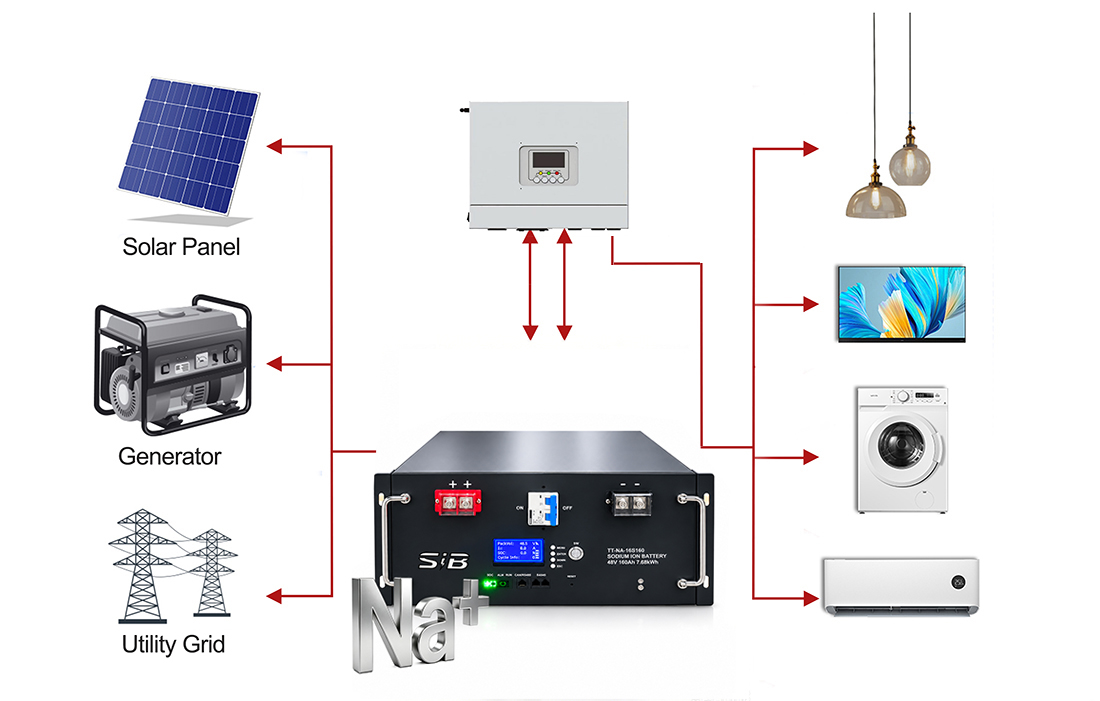
Before purchasing a sodium-ion battery for a solar energy storage system, check these eight points:
System voltage: Confirm that the battery’s actual operating-voltage range matches the inverter or charge controller.
Energy capacity: Calculate storage requirements in kWh, not only Ah.
Usable energy: Check the permitted depth of discharge and the manufacturer’s recommended operating limits.
Charging compatibility: Verify the required charging voltage, current, and temperature range.
BMS communication: Confirm whether CAN, RS485, or another interface is supported and compatible with the inverter.
Operating environment: Check charging and discharging temperature limits for the installation location.
Protection and safety: Review the BMS functions, product test reports, and applicable transport and safety documentation.
Supplier capability: Request a current datasheet, inspection records, warranty terms, and technical support arrangements.
The best battery is not necessarily the one with the highest Ah rating. It is the one that provides the required usable energy and power while working safely and reliably with the complete solar system.
Solar power generation does not always match electricity consumption. A home may generate more electricity than it needs during the day, while demand increases in the evening. An off-grid installation may also need stored energy to supply loads when sunlight is insufficient.
A battery energy storage system helps address this difference by storing electricity for later use.
Sodium-ion batteries are attracting attention as one option for stationary energy storage. They use sodium ions as charge carriers and share fundamental electrochemical principles with lithium-ion batteries, but their materials and cell characteristics are different.
1.1 Material availability and supply-chain diversification
Sodium is widely available, and sodium-ion chemistry does not require lithium as an active battery material. This creates opportunities to diversify battery supply chains and reduce direct exposure to lithium price fluctuations.
The International Energy Agency (IEA) reported in February 2026 that global sodium-ion battery production in 2025 remained below 1% of lithium-ion production. It also noted that sodium-ion supply chains are still less developed, although investment and commercial deployment are increasing.
This is an important purchasing consideration: evaluate the manufacturer’s actual production capability, delivery schedule, technical documentation, and after-sales support rather than relying only on forecasts about future battery prices.
Low-temperature operation is one of the most discussed advantages of sodium-ion technology.
According to the IEA, the latest generation of sodium-ion batteries can retain around 90% of nominal capacity at temperatures as low as -40°C and can operate at temperatures as high as 70°C.
These figures describe the latest generation of technology, not every commercially available sodium-ion battery. Actual performance depends on the cell chemistry, pack design, BMS settings, discharge rate, and test conditions.
For a solar project in a cold region, always request the temperature-performance data for the exact battery model being considered. Pay particular attention to the difference between charging and discharging temperature limits. A battery may be able to discharge at a low temperature while still requiring a higher minimum temperature for charging.
2. How to Choose the Right Battery Capacity for Your Solar System
Battery capacity is one of the first specifications buyers compare. However, Ah alone does not tell you how much energy a battery can store.
To compare batteries with different voltage ratings, convert nominal voltage and capacity into kilowatt-hours.
The basic calculation is:
For example:
A 48V 100Ah battery has approximately 4.8kWh of nominal energy.
A 48V 160Ah battery has approximately 7.68kWh of nominal energy.
A 12V 400Ah battery has approximately 4.8kWh of nominal energy when calculated using a nominal 12V rating.
These are arithmetic estimates based on the stated nominal voltage. The exact rated voltage on the approved datasheet should be used for final system calculations.
The following table provides a preliminary comparison of the three product configurations.
| Battery configuration | Nominal capacity | Illustrative nominal energy | Potential application |
|---|---|---|---|
| 48V 100Ah sodium-ion battery | 100Ah | 4.8kWh | Smaller solar storage and backup systems |
| 48V 160Ah sodium-ion battery | 160Ah | 7.68kWh | Larger residential and commercial storage requirements |
| 12V 400Ah sodium-ion battery | 400Ah | 4.8kWh at 12V | 12V-based solar, RV, marine, and customized storage systems |
Important: Nominal energy is not the same as usable energy. Actual energy available to the load depends on the permitted depth of discharge, battery operating limits, inverter efficiency, temperature, and load profile.
A simple preliminary calculation is:
For example, suppose a solar installation requires an average load of 800W and has 4kWh of usable battery energy.
4,000Wh ÷ 800W = 5 hours.
This is a simplified estimate. It does not account for inverter losses, changing loads, battery temperature, or additional system consumption.
For a more realistic design, buyers should calculate the total daily energy consumption of the loads that must remain powered during periods without solar generation.
Before selecting a battery, prepare a load list.
| Electrical load | Example power | Daily operating time | Daily energy |
|---|---|---|---|
| LED lighting | 100W | 5 hours | 0.5kWh |
| Refrigerator | 150W average | 10 hours | 1.5kWh |
| Television and electronics | 150W | 4 hours | 0.6kWh |
| Small appliances | 300W | 2 hours | 0.6kWh |
| Total | — | — | 3.2kWh |
This example represents an illustrative daily energy requirement, not a measured household profile.
If the project needs to supply 3.2kWh during a period without solar generation, the battery must provide sufficient usable energy after accounting for the inverter and other system losses.
Buyers should also consider days of autonomy. A system designed to support one night has different storage requirements from an off-grid system expected to operate through two or three cloudy days.
3. Check Solar Inverter and Charge Controller Compatibility
Inverter compatibility is one of the most important points when purchasing a sodium battery for solar storage.
A battery can have the correct nominal voltage but still be unsuitable for a particular inverter because its charging voltage, discharge cut-off voltage, current limits, or communication protocol do not match.
The term 48V is commonly used to describe a battery system class. It does not guarantee that two battery products have identical electrical operating ranges.
For example, the published MICA POWER product specifications currently show:
| Parameter | 48V 100Ah model MC-SIB48100P | 48V 160Ah model MC-NA-16S160 |
|---|---|---|
| Nominal voltage | 48V | 48V |
| Rated capacity | 100Ah | 160Ah |
| Published charging voltage | 64V | 55.2V |
| Published discharge cut-off | 32V | 24V |
| Published charging temperature | 0°C to 45°C | 0°C to 45°C |
| Published discharging temperature | -30°C to 60°C | -40°C to 60°C |
Source: MICA POWER product pages for the 48V 100Ah rack-mounted model and the 48V 160Ah rack-mounted model.
These published figures show why buyers must obtain the latest approved datasheet for the exact model and revision. They should not assume that one inverter charging profile can be used for both products.
Before ordering, confirm:
Inverter battery voltage range.
Battery maximum charging voltage.
Battery discharge cut-off voltage.
Maximum continuous charge current.
Maximum continuous discharge current.
BMS communication requirements.
Supported CAN or RS485 protocol and inverter model.
Whether the inverter can operate with user-defined battery settings.
Some solar energy storage batteries support communication with an inverter through CAN or RS485.
However, the presence of a CAN or RS485 port does not automatically mean that the battery is compatible with every inverter.
The communication protocol, baud rate, data format, pin assignment, and firmware configuration may differ between manufacturers.
For a project requiring communication-based control, ask the battery supplier and inverter supplier to confirm compatibility using the exact battery and inverter models.
If communication is not supported, determine whether the inverter allows an approved voltage-based operating mode and whether that mode is suitable for the battery.
The charge controller must also be configured for the selected sodium-ion battery.
Check the controller’s programmable charging settings, maximum charging current, battery voltage range, and temperature-related control functions.
Do not use a generic lithium or lead-acid charging profile without confirming that it matches the sodium-ion battery manufacturer’s requirements.
4. Understand BMS Protection and Battery Safety
The battery management system is a central part of a sodium-ion battery energy storage system.
It monitors battery operating conditions and helps protect the cells against operation outside approved limits.
Depending on the product design, BMS functions may include:
Cell or module voltage monitoring.
Overvoltage protection.
Undervoltage protection.
Charge and discharge overcurrent protection.
Short-circuit protection.
Temperature monitoring.
Over-temperature and under-temperature protection.
Cell balancing, where supported.
SOC estimation and communication.
A product description that simply says “built-in BMS” is not enough for a professional buyer.
Request the protection thresholds and operating limits relevant to your application. For example, confirm the maximum continuous current, peak current and duration, charging temperature limits, and protection recovery behavior.
The BMS settings must be matched to the cell chemistry and pack configuration. They should not be copied from an unrelated lithium-ion battery profile.
Battery safety qualification and transport compliance serve different purposes.
UN 38.3 addresses testing requirements for batteries transported under the applicable dangerous-goods rules. It is not a substitute for product-specific functional testing or a complete system safety assessment.
Ask the supplier for documentation that applies to the exact battery model and configuration being purchased. Depending on the target market and application, additional national, regional, or application-specific requirements may apply.
For stationary energy storage projects, the system integrator should also consider installation, enclosure, wiring protection, ventilation where required by the product design, fire protection strategy, and local electrical regulations.
5. Evaluate Temperature Performance and Installation Conditions
A sodium ion solar battery may be considered for projects in regions with low ambient temperatures, but buyers should not assume that all sodium-ion products have the same temperature limits.
The operating temperature range must be checked separately for charging, discharging, and storage.
5.1 Charging and discharging temperatures are different
Some batteries can discharge at temperatures below 0°C but have a higher minimum temperature for charging.
This difference is important in off-grid solar systems. A battery may be able to supply electricity during a cold night, but charging from the solar array the following morning may still be restricted by its BMS.
For example, the published MICA POWER 48V 100Ah and 48V 160Ah product pages list a charging range of 0°C to 45°C, while their listed discharge ranges differ. These are model-specific specifications and should be confirmed against the current datasheet before installation.
Before selecting a battery, consider:
Indoor or outdoor installation.
Minimum and maximum ambient temperatures.
Direct sunlight exposure.
Humidity and condensation.
Dust and water exposure.
Ventilation and enclosure requirements.
Mounting orientation and structural support.
Cable routing and maintenance access.
A battery designed for a protected equipment room may require additional enclosure protection for an outdoor installation.
6. How to Evaluate a Sodium-Ion Battery Supplier
A reliable solar battery supplier should provide more than a product photograph and a nominal capacity.
Before placing a bulk order or approving an OEM project, we recommend reviewing the following points.
The datasheet should identify:
Exact battery model.
Nominal voltage and capacity.
Minimum rated capacity and test conditions.
Charging voltage and current limits.
Discharge cut-off voltage.
Maximum continuous and peak current.
Charging and discharging temperature ranges.
BMS functions and communication interfaces.
Dimensions and weight.
Recommended storage conditions.
If a product page and datasheet show different electrical values, ask the manufacturer to confirm which revision governs the order.
Ask whether the manufacturer checks cell voltage, capacity, and internal resistance before assembly. Also review module assembly, welding, wiring, BMS installation, aging, and final inspection procedures.
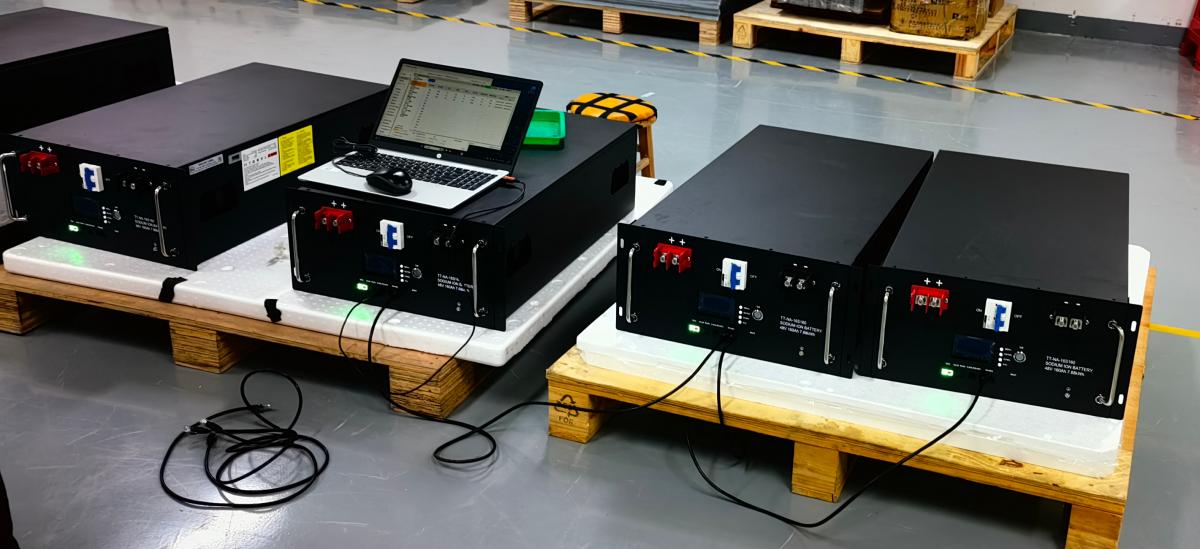
Solar projects may have different requirements for capacity, enclosure size, terminals, monitoring displays, communication, and mounting.
For OEM and ODM projects, discuss these details before production begins. Confirm whether customization affects the product’s electrical design, test plan, lead time, certification scope, or warranty.
Ask for written warranty conditions, including:
Warranty period.
Capacity or performance conditions, if specified.
Permitted operating temperature.
Installation requirements.
Exclusions and claim procedure.
Technical support availability.
Replacement and repair arrangements.
A warranty period alone does not describe the complete service commitment. Buyers should understand the conditions under which the warranty applies.
7. Which MICA POWER Sodium-Ion Battery Is Suitable for Your Solar Project?
MICA POWER offers several sodium-ion battery configurations that can be evaluated for different energy storage requirements.
Yes, sodium-ion batteries can be used in suitable stationary solar energy storage systems. Before purchasing, confirm the battery’s voltage range, usable capacity, charging limits, BMS functions, inverter compatibility, and operating temperature requirements.
At a nominal voltage of 48V, a 100Ah battery has approximately 4.8kWh of nominal energy. The usable energy will be lower or otherwise limited according to the manufacturer’s permitted operating range, depth of discharge, inverter efficiency, and system conditions.
At the same nominal voltage, a 48V 100Ah battery represents approximately 4.8kWh of nominal energy, while a 48V 160Ah battery represents approximately 7.68kWh. The 160Ah configuration provides a higher nominal energy capacity, but both models must be checked separately for charging voltage, discharge limits, current ratings, and inverter compatibility.
Possibly, but compatibility must be confirmed. Check the inverter’s battery voltage range, programmable charging settings, current limits, and BMS communication requirements. A nominal voltage label alone is not enough to establish compatibility.
Provide your system voltage, required battery capacity or daily energy consumption, inverter model, charging source, maximum charge and discharge current, installation environment, and expected backup time. This information helps the supplier assess a suitable configuration.
Purchasing a sodium ion battery for solar energy storage requires more than selecting a voltage and capacity. Buyers should evaluate usable energy, charging and discharging limits, inverter compatibility, BMS protection, temperature performance, installation conditions, product documentation, and supplier support.
For smaller or modular installations, a 48V 100Ah configuration may be worth evaluating. Projects requiring more nominal storage may consider a 48V 160Ah battery. A 12V 400Ah configuration may suit a different low-voltage system architecture, provided its confirmed datasheet and the rest of the solar system are compatible.
At MICA POWER, we provide sodium-ion battery solutions for solar energy storage, backup power, and customized applications. Our team can discuss battery capacity, system voltage, BMS requirements, and OEM/ODM options based on your project specifications.
Send us your system voltage and required capacity to discuss a suitable battery solution.
Contact MICA POWER


