
- All
- Product Name
- Product Keyword
- Product Model
- Product Summary
- Product Description
- Multi Field Search


Views: 0 Author: Site Editor Publish Time: 2026-10-26 Origin: Site


If you are comparing sodium-ion vs lead-acid batteries, there is no single answer for every application.
For traditional low-cost backup systems where initial purchase price, established infrastructure and simple replacement are the main concerns, lead-acid remains a practical and mature battery technology.
However, for applications that require higher usable energy, better energy efficiency, longer service life, lower maintenance, faster charging or stronger
low-temperature performance, sodium-ion batteries can offer significant advantages.
From our perspective, the most useful comparison is not simply “Which chemistry is newer?” but rather:
Which battery can deliver the required energy and power over the expected operating life at the lowest practical total cost?
This distinction matters because battery chemistry affects much more than the purchase price.
It influences usable capacity, charging requirements, system efficiency, weight, installation space, maintenance, operating temperature and replacement frequency.
Current industry data illustrates the difference. IRENA reports present-day gravimetric energy-density ranges of approximately 25–50 Wh/kg for lead-acid and 90–160 Wh/kg for sodium-ion batteries, while reported cycle-life ranges are approximately 250–2,000 cycles for lead-acid and 500–8,000 cycles for sodium-ion, depending heavily on the specific technology and operating conditions. IRENA also reports an approximate sodium-ion efficiency of 92%. 国际可再生能源署
The important qualification is that these are technology ranges, not guaranteed specifications for every battery.
So, let's look at the comparison in practical terms.
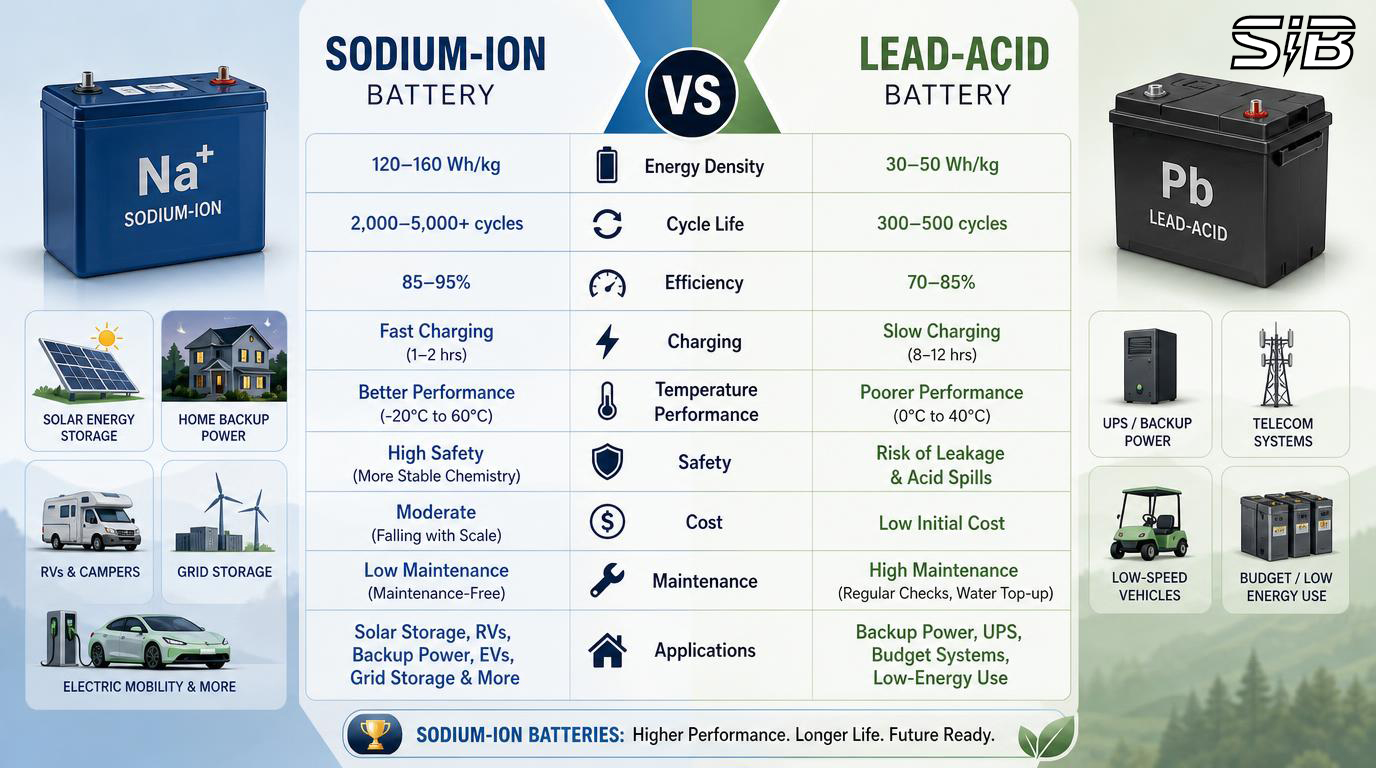
| Performance factor | Sodium-ion battery | Lead-acid battery |
Basic chemistry | Sodium-ion electrochemical system | Lead dioxide / lead-based electrochemical system |
Typical gravimetric energy density | About 90–160 Wh/kg in current industry ranges | About 25–50 Wh/kg |
Typical cycle-life range | About 500–8,000 cycles depending on chemistry and conditions | About 250–2,000 cycles depending on design and depth of discharge |
Round-trip/energy efficiency | Around 92% in IRENA's technology comparison | Broadly around 63–90% in IRENA's comparison |
Low-temperature performance | One of the major advantages of newer sodium-ion technologies | Performance and available capacity can decrease significantly in cold conditions |
Charging capability | Generally supports higher charging rates than conventional lead-acid | Generally slower charging |
Maintenance | Generally low maintenance | Flooded lead-acid may require more maintenance |
Weight for the same stored energy | Generally lower | Generally higher |
Depth-of-discharge potential | Depends on cell and BMS design | Deep discharge can significantly affect service life |
Supply-chain maturity | Developing | Highly mature |
Recycling infrastructure | Developing | Highly established |
Best-known applications | Energy storage, backup power, low-temperature applications, selected mobility and industrial systems | Automotive starting, UPS, telecom, backup power, industrial applications |
Main advantage | Balance of performance, temperature capability and material availability | Mature technology and established low upfront cost |
Main limitation | Lower energy density and less mature manufacturing ecosystem than lithium-ion | Lower energy density, heavier construction and shorter life in demanding cycling applications |
The table above combines broad industry ranges from IRENA and peer-reviewed technical literature. Actual performance depends on cell chemistry, battery design, charging protocol, temperature, depth of discharge and application. 国际可再生能源署
A sodium-ion battery, commonly abbreviated as SIB or Na-ion battery, is a rechargeable battery that stores and releases energy through the reversible movement of sodium ions between electrodes.
Its basic operating principle is similar to that of a lithium-ion battery.
During charging, sodium ions move through the electrolyte toward the negative electrode. During discharge, they move back toward the positive electrode while electrons travel through the external circuit to power the connected load.
The major difference is the charge carrier.
Instead of lithium ions, sodium-ion batteries use sodium ions (Na⁺).
Sodium is an abundant element found widely in nature. This creates an opportunity to diversify battery material supply chains and reduce dependence on lithium resources.
The IEA identifies sodium-ion as an emerging battery technology that is entering a scale-up phase. At the same time, the IEA emphasizes that sodium-ion manufacturing remains much smaller than lithium-ion manufacturing and that energy density is still one of its limitations. IEA
Lead-acid is one of the most established rechargeable battery technologies now.
It uses lead-based electrodes and sulfuric-acid electrolyte to store electrical energy.
Lead-acid batteries have been used commercially for well over a century and remain common in:
Automotive starting systems
UPS systems
Telecommunications
Emergency backup
Industrial equipment
Solar storage
Golf carts
Marine applications
Off-grid systems
One of lead-acid's biggest advantages is maturity.
Manufacturers, distributors, installers and recyclers have extensive experience with the technology. Standardized form factors are also widely available.
This makes lead-acid attractive when customers prioritize availability, familiarity and low initial purchase cost.
However, a mature technology is not automatically the most efficient technology for every modern energy-storage application.
Energy density is one of the clearest differences between the two technologies.
Energy density describes how much energy a battery can store relative to its weight or volume.
IRENA's technology comparison gives a present-day gravimetric energy-density range of approximately:
Lead-acid: 25–50 Wh/kg
Sodium-ion: 90–160 Wh/kg
This means sodium-ion batteries can provide substantially more stored energy for a given battery mass in many designs. 国际可再生能源署
Another technical comparison published in Clean Energy reports approximately 30–50 Wh/kg for lead-acid versus 100–150 Wh/kg for sodium-ion, again showing a substantial difference. OUP Academic
This matters when battery weight or installation space is limited.
For example, consider an application requiring several kilowatt-hours of stored energy.
A lead-acid system may require a relatively large and heavy battery bank. A sodium-ion solution can potentially reduce the battery mass required for the same nominal energy.
This does not mean sodium-ion is always compact.
Modern lithium-ion batteries generally still provide higher energy density than sodium-ion technology. The IEA reports that leading sodium-ion cells can reach around 175 Wh/kg, while the latest LFP cells can reach around 205 Wh/kg. IEA
So the practical hierarchy is not simply:
Sodium-ion > lithium-ion > lead-acid in every metric.
Instead, sodium-ion sits between conventional lead-acid and advanced lithium-ion in several important performance categories.
Cycle life is another important consideration.
One battery cycle generally refers to a complete equivalent charge-discharge cycle. However, manufacturers may define cycle-life testing differently, so numbers should always be compared using the same test conditions.
IRENA reports:
Lead-acid: approximately 250–2,000 cycles
Sodium-ion: approximately 500–8,000 cycles
The wide ranges demonstrate an important point: battery chemistry alone does not determine cycle life. Cell design, depth of discharge, temperature and operating strategy can dramatically change real-world results. 国际可再生能源署
A lead-acid battery used for occasional emergency backup may perform very differently from one repeatedly cycled every day in a solar energy-storage system.
We therefore recommend evaluating cycle life together with:
Depth of discharge + temperature + charge/discharge rate + daily cycling frequency + warranty conditions.
For a battery that cycles every day, service life can have a greater economic impact than the initial purchase price.
Charging behavior is particularly important for solar storage, backup systems and applications where the battery has limited time to recharge.
Traditional lead-acid batteries generally prefer relatively moderate charging rates. High charging currents can increase heat generation, gassing and degradation depending on the battery design.
Sodium-ion technology can support higher charging rates in suitable cell designs.
A peer-reviewed comparison reports typical sodium-ion charging rates of approximately 1–3C, compared with around 0.1–0.3C for lead-acid in the cited comparison. OUP Academic
However, I would not recommend using these values as a universal specification.
A battery's maximum charging current must always come from the manufacturer's cell and battery-pack specification.
For a solar system, faster charging can be valuable because available solar generation may fluctuate throughout the day.
Battery efficiency determines how much of the energy put into a battery can ultimately be recovered.
Every percentage point matters in applications with frequent cycling.
IRENA's comparison gives sodium-ion batteries an approximate efficiency of 92%, while lead-acid is listed across a much wider range of approximately 63–90%, depending on technology and operating conditions. 国际可再生能源署
This creates an important difference in high-frequency applications.
Imagine a solar-storage system that charges and discharges the battery every day.
If a battery wastes more energy during each cycle, the system needs additional electricity generation to deliver the same usable output.
Therefore, when comparing battery technologies, we recommend looking beyond the battery's nominal Ah or kWh rating.
A better question is:
How many usable kilowatt-hours will the system deliver over its expected service life?
This is one area where sodium-ion technology is attracting considerable attention.
Cold temperatures can reduce battery performance and available capacity.
The IEA reports that the latest sodium-ion batteries can retain approximately 90% of nominal capacity at temperatures as low as -40°C in certain advanced designs, while also supporting operation at temperatures as high as 70°C. IEA
This does not mean every sodium-ion battery performs identically at -40°C.
Battery chemistry, cell construction, electrolyte formulation, BMS strategy and heating systems all matter.
Nevertheless, low-temperature capability is becoming one of sodium-ion's most interesting advantages.
For applications such as:
Cold-climate energy storage
Outdoor equipment
RVs
Marine systems
Industrial equipment
Backup systems
Certain starter applications
temperature performance can be more important than maximum energy density.
MICA POWER also develops sodium-ion battery configurations intended for low-temperature applications, with specific operating ranges determined by the individual product design.


Safety deserves a more careful explanation.
It would be misleading to say that sodium-ion batteries are automatically “safe” while lead-acid batteries are “unsafe.”
Both technologies can be designed safely when the battery is correctly engineered and operated.
Lead-acid batteries, particularly flooded designs, have well-known considerations including:
Acid electrolyte
Hydrogen generation during charging
Ventilation requirements
Risk of leakage
Heavy battery construction
Corrosion
Sodium-ion batteries do not use sulfuric-acid electrolyte, and some sodium-ion chemistries have demonstrated favorable safety characteristics.
However, battery safety remains a system-level engineering issue.
At MICA POWER, we evaluate:
Cell chemistry
BMS protection
Overcharge protection
Over-discharge protection
Short-circuit protection
Overcurrent protection
Temperature monitoring
Mechanical structure
Electrical connections
Charging strategy
Manufacturing quality
This is particularly important when developing OEM or ODM battery packs.
Maintenance can easily be overlooked when comparing battery prices.
Some traditional flooded lead-acid batteries may require periodic electrolyte checks and water replenishment. Ventilation and installation conditions may also require attention.
Sealed lead-acid designs reduce some of these maintenance requirements but still remain sensitive to operating conditions and charging practices.
Sodium-ion battery packs generally use a BMS and sealed cell construction, which can reduce routine maintenance requirements.
This can be useful for:
Remote energy systems
Solar installations
Telecom backup
RVs
Marine equipment
Commercial backup systems
The exact maintenance requirements should always be based on the final battery design.
Cost is probably the most misunderstood part of this comparison.
If we compare only purchase price, lead-acid can remain highly competitive.
Its mature manufacturing base and established recycling network provide significant economic advantages.
But purchase price is not the same as total cost of ownership.
A better calculation considers:
Total Cost of Ownership = Purchase Cost + Installation + Energy Losses + Maintenance + Replacement + Disposal/Recycling
A battery that costs less initially but requires more frequent replacement may not be the cheapest solution over five or ten years.
The IEA currently notes that sodium-ion batteries are becoming increasingly relevant for energy storage, but also stresses that their manufacturing scale remains far below lithium-ion and that their cost competitiveness depends on market and technology conditions. IEA
Therefore, I would avoid making a blanket claim such as “sodium-ion is always cheaper than lead-acid.”
The more defensible conclusion is:
Sodium-ion can become economically attractive when its longer usable service life, efficiency, charging capability, temperature performance and reduced maintenance offset its initial system cost.
Sodium is extremely abundant compared with lithium resources.
The Battery Council International notes that sodium is widely available in seawater, salt flats and minerals around the world. Battery Council International
This is one reason sodium-ion technology is attracting interest as a way to diversify battery supply chains.
Lead-acid has another major advantage that should not be ignored: its recycling ecosystem is highly mature.
Lead-acid batteries have been recycled at large scale for decades, and their established collection and recycling infrastructure is an important part of their environmental profile.
Therefore, the environmental comparison should not be reduced to:
“Sodium is abundant, therefore sodium-ion is automatically greener.”
Battery sustainability depends on the complete lifecycle:
Raw materials → cell manufacturing → battery assembly → transportation → use → second life → recycling
A recent peer-reviewed study examining renewable-energy storage technologies found that sodium-ion systems can have favorable environmental characteristics in certain scenarios, but system-level results depend on the specific technology and application. 科学直通车
For solar energy storage, I would generally consider sodium-ion a strong alternative to lead-acid, particularly where the system cycles frequently.
Solar-storage applications can benefit from:
High usable energy
Efficient charge/discharge
Long cycle life
Low maintenance
Good temperature performance
Reliable BMS control
Lead-acid can still make sense for smaller systems with infrequent cycling where the lowest initial investment is the primary objective.
But for a solar system that charges and discharges every day, the economic analysis should include lifetime energy throughput rather than only battery purchase price.
MICA POWER offers sodium-ion battery configurations ranging from low-voltage battery packs to larger energy-storage solutions. Our published product range includes 12V/12.4V sodium-ion battery packs and 48V sodium-ion energy-storage batteries. SIB Batteries
Yes, in many applications—but not all.
Sodium-ion batteries can be considered as a lead-acid alternative for applications where their technical characteristics provide a measurable benefit.
Potential applications include:
Sodium-ion can be attractive for residential and commercial solar storage because stationary systems are less sensitive to battery weight than vehicles.
For backup applications with frequent testing or cycling, efficiency and cycle life can become important.
Lower battery weight and reduced maintenance can be valuable in mobile applications.
Long service life and low maintenance can reduce the need for battery replacement and site visits.
Certain sodium-ion battery designs are being developed for automotive and powersport starting applications, particularly where low-temperature performance is valuable.
However, direct replacement should never be assumed solely from nominal voltage.
The charging voltage, BMS, charger, alternator, inverter, wiring, protection settings and mechanical dimensions all need to be checked.
Lead-acid may still be the better choice when:
Initial purchase price is the dominant factor.
The battery is used only occasionally.
Weight and size are not important.
Existing equipment is specifically designed for lead-acid.
Local replacement and recycling infrastructure strongly favor lead-acid.
The application has relatively low cycling requirements.
Lead-acid is a mature technology, and there is no reason to replace a technology simply because a newer chemistry exists.
The correct approach is application-based engineering.
I would consider sodium-ion particularly attractive when the project needs a combination of:
Better energy density than traditional lead-acid
Frequent cycling
Higher charging capability
Lower maintenance
Strong low-temperature performance
Reduced dependence on lithium
Battery-pack customization
Long-term energy-storage operation
The IEA's 2026 assessment similarly identifies stationary storage and cold-climate applications as areas where sodium-ion can be particularly relevant, while noting that lower energy density and manufacturing scale remain challenges. IEA
Higher energy density than conventional lead-acid
Potentially longer cycle life
High charging capability in suitable designs
Strong low-temperature performance in advanced cells
Lower routine maintenance
Sodium is widely available
Suitable for customized battery-pack development
Attractive for stationary energy storage
Lower energy density than leading lithium-ion technologies
Manufacturing ecosystem is still developing
Commercial availability is more limited than lead-acid
Performance varies substantially between sodium-ion chemistries
Initial price may not always be lower than lead-acid
Mature and widely understood
Broad global availability
Established recycling infrastructure
Competitive initial purchase price
Many standardized battery formats
Proven performance in starting and backup applications
Heavy
Lower energy density
Slower charging
Lower efficiency in many operating conditions
Deep cycling can reduce service life
Some designs require maintenance
Cold temperatures can reduce available capacity
Frequent cycling can increase replacement requirements
At MICA POWER, we do not believe that the future of batteries will be dominated by one chemistry.
Different applications require different compromises.
Lead-acid has decades of commercial experience behind it. Lithium-ion has established a strong position because of its high energy density and manufacturing scale. Sodium-ion is developing its own position around material availability, low-temperature performance, safety characteristics and selected energy-storage applications.
Our role as a battery manufacturer is therefore not simply to promote one chemistry.
We focus on matching the battery to the application.
MICA POWER was founded in 2013 and specializes in the R&D, production and sales of energy-storage batteries and systems, including sodium-ion batteries and LiFePO4 battery packs. Our team brings more than 20 years of experience in the lithium-battery industry.
For sodium-ion projects, we can work around requirements such as:
Battery voltage
Capacity
Charge current
Discharge current
BMS configuration
Communication interface
Operating temperature
Mechanical dimensions
Connector configuration
Installation method
OEM/ODM requirements
Our published sodium-ion products include 12V and 12.4V battery packs as well as 48V energy-storage configurations. SIB Batteries
For customers looking at sodium-ion as a lead-acid replacement, we recommend evaluating the entire system rather than simply comparing Ah ratings.
For example, a 12V 200Ah lead-acid battery and a 12V sodium-ion battery should not automatically be considered equivalent simply because both are labeled “200Ah.”
The usable energy, allowable depth of discharge, charging characteristics, efficiency and expected cycle profile can be very different.
Before making a final decision, I recommend asking these eight questions:
Daily cycling favors technologies designed for repeated charge/discharge operation.
Cold-climate applications deserve particular attention because temperature behavior can significantly influence usable capacity.
If weight matters, sodium-ion can have an advantage over lead-acid.
Higher energy density can reduce the physical footprint required for a given energy capacity.
Applications with short recharge windows should evaluate maximum recommended charging current.
Compare expected lifetime energy throughput rather than only purchase price.
This is particularly important when replacing lead-acid with another battery chemistry.
Include battery, charger, BMS, installation, maintenance, energy losses and future replacement.
This approach usually produces a much more meaningful result than simply asking which battery is cheaper.
So, is sodium-ion better than lead-acid?
For many modern energy-storage applications, sodium-ion offers a stronger technical profile, particularly in energy density, cycling potential, charging capability, efficiency and low-temperature performance.
But lead-acid remains highly relevant because it is mature, widely available, relatively inexpensive upfront and supported by an established recycling infrastructure.
The better choice depends on the application.
Choose lead-acid when: initial purchase cost, established availability and occasional use are the highest priorities.
Consider sodium-ion when: you need a lighter and more efficient battery, frequent cycling, low maintenance, stronger cold-temperature performance or a modern alternative to conventional lead-acid systems.
The broader battery industry is moving toward a multi-chemistry future. The IEA's current assessment supports this view: sodium-ion is scaling commercially, but it still faces lower energy density and a less mature manufacturing ecosystem compared with established lithium-ion technologies. IEA
From our perspective at MICA POWER, the important question is therefore not “Which battery chemistry will replace everything else?”
It is:
“Which battery chemistry provides the best technical and economic fit for this particular application?”
That is the question we believe battery manufacturers and system integrators should answer before selecting a battery.
For many frequently cycled energy-storage applications, sodium-ion can offer advantages in energy density, efficiency, charging capability and cycle life. Lead-acid can remain attractive where low initial cost and mature infrastructure are the priorities.
Yes. Sodium-ion batteries can replace lead-acid in selected applications, including solar storage, backup power, RV, marine and some industrial applications. Compatibility with the charger, BMS, voltage range and equipment must be verified before replacement.
Generally, yes. IRENA reports approximately 92% efficiency for sodium-ion batteries compared with a broad 63–90% range for lead-acid batteries, depending on technology and operating conditions. 国际可再生能源署
They can. Reported industry cycle-life ranges are approximately 500–8,000 cycles for sodium-ion and 250–2,000 cycles for lead-acid, but actual life depends strongly on battery chemistry, depth of discharge, temperature and operating conditions. 国际可再生能源署
Certain modern sodium-ion batteries perform particularly well at low temperatures. The IEA reports that some newer sodium-ion technologies can retain around 90% of nominal capacity at temperatures as low as -40°C. Actual performance depends on the specific battery design. IEA
Safety cannot be determined by chemistry alone. Sodium-ion batteries can have favorable safety characteristics, while lead-acid batteries have well-established safety practices. Cell design, BMS protection, charging, thermal management and manufacturing quality all matter.
Not necessarily. Lead-acid can have a lower initial purchase price because of its mature manufacturing and supply chain. Sodium-ion may become more economically attractive when lifetime cycling, efficiency, maintenance and replacement costs are included.
Not automatically. The battery voltage may look similar while charging requirements, voltage limits, BMS settings and current capability are different. Always check the battery manufacturer's specifications and the equipment manufacturer's requirements.
Yes. Stationary solar storage is one of the applications where sodium-ion technology has significant potential. The battery should be evaluated according to usable capacity, cycle life, efficiency, temperature range, cost, BMS and inverter compatibility.
Sodium-ion batteries use sodium ions as their primary charge carriers rather than lithium ions. However, the exact material composition varies between sodium-ion chemistries and manufacturers.
The biggest limitation today is generally lower energy density than advanced lithium-ion batteries, combined with a less mature manufacturing ecosystem. The IEA also identifies supply-chain development and manufacturing scale as continuing challenges. IEA
Sodium-ion is likely to become an important battery technology, but it is unlikely to eliminate every other chemistry. Different battery technologies will continue to serve different applications according to their cost, energy density, temperature performance, cycle life and safety requirements.


