
- All
- Product Name
- Product Keyword
- Product Model
- Product Summary
- Product Description
- Multi Field Search


Views: 0 Author: Site Editor Publish Time: 2026-11-11 Origin: Site


Introduction: Why Are Sodium-Ion Batteries Gaining Attention in Solar Storage?
As solar energy becomes an increasingly important part of residential, commercial and off-grid power systems, choosing the right battery has become just as important as selecting the solar panels and inverter.
One question we increasingly encounter from energy storage buyers is: Can a sodium-ion battery be used for solar energy storage, and which capacity is suitable for a 48V system?
Sodium-ion batteries are attracting attention as an alternative to conventional lithium-ion battery technologies. They use sodium ions to store and
release electrical energy and offer potential advantages in material availability and low-temperature performance. At the same time, their energy density, commercial maturity and cost competitiveness need to be evaluated against the requirements of each project.
For stationary solar storage, a rack-mounted design is particularly practical. It allows batteries to be installed in an organized cabinet or equipment rack and can support modular system configurations when the manufacturer permits parallel expansion.
In this guide, we will examine how a sodium-ion battery for solar works, compare 48V 100Ah, 160Ah and 200Ah capacity options, explain the key technical specifications and discuss how to select a suitable battery for different solar applications.
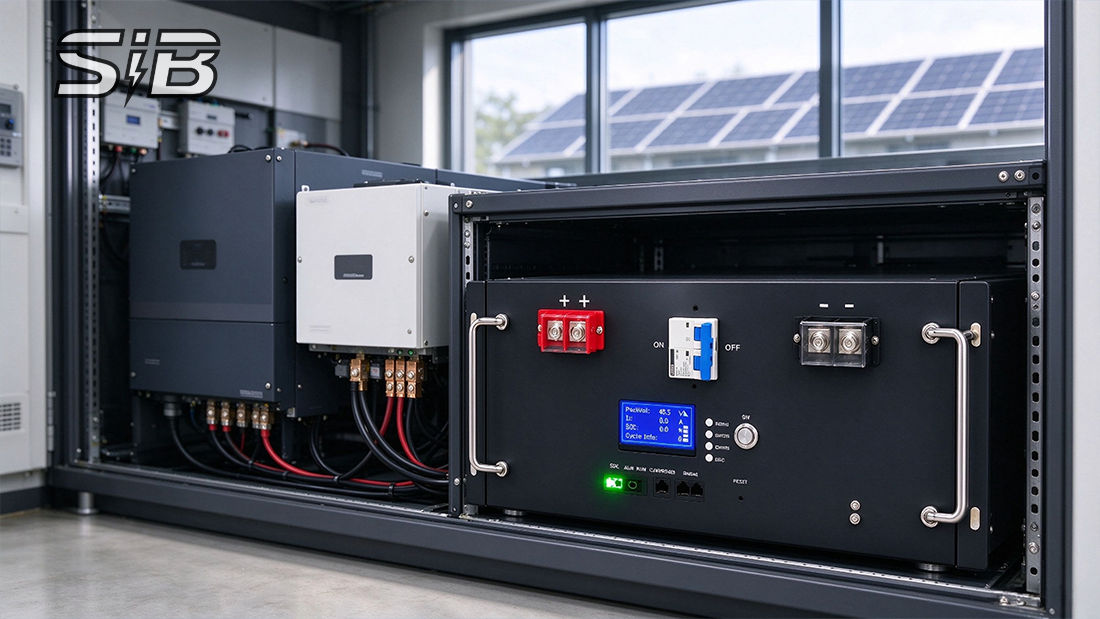
A sodium-ion battery is a rechargeable battery that stores and releases electricity through the movement of sodium ions between its electrodes during charging and discharging.
Its working principle is similar to that of a lithium-ion battery. However, sodium ions replace lithium ions as the charge carriers. This difference affects the battery's material requirements, electrochemical characteristics and performance.
A solar panel generates DC electricity when exposed to sunlight. During periods of sufficient solar generation, electricity can supply connected loads while surplus energy is directed to the battery for storage.
When solar production decreases, such as at night or during cloudy weather, the battery releases stored electricity through a compatible inverter to supply household or commercial loads.
A typical solar energy storage system includes:
Solar panels: Convert sunlight into DC electrical energy.
Solar charge controller or hybrid inverter: Regulates solar power and manages battery charging.
Sodium-ion battery: Stores surplus electricity for later use.
Battery Management System (BMS): Monitors battery conditions and controls protective functions.
Inverter: Converts DC power into AC electricity for compatible appliances and equipment.
Electrical loads: Consume the electricity generated or stored by the system.
The exact arrangement depends on whether the project uses a hybrid inverter, an off-grid inverter or a separate MPPT charge controller.
There are several reasons why sodium-ion technology is attracting interest in stationary energy storage.
Abundant raw material resources
Sodium is widely available in nature. Its availability creates opportunities to diversify battery material supply chains and reduce dependence on lithium-based materials.
However, abundant sodium does not automatically mean that every sodium-ion battery is cheaper than an equivalent LiFePO4 battery. Manufacturing scale, cell materials, production yield and system integration all influence the final cost.
Potential advantages in low-temperature performance
Some sodium-ion battery designs demonstrate strong low-temperature performance compared with conventional lithium-ion chemistries, particularly certain LFP designs.
The International Energy Agency (IEA) reports that the latest generation of sodium-ion batteries can retain around 90% of nominal capacity at temperatures as low as -40°C. This is a technology-level result, not a specification that applies to every commercial sodium-ion battery pack.
For solar buyers, the important point is to check the actual operating-temperature range of the selected battery model.
Practical for stationary energy storage
For a stationary solar installation, battery weight is often less restrictive than it is in electric vehicles. A rack-mounted battery can therefore be evaluated according to its usable energy, power capability, operating temperature, service life and installation requirements.
A 48V rack-mounted sodium-ion battery is designed for integration into a compatible DC energy storage system. Its capacity is usually expressed in ampere-hours (Ah), while its energy storage is expressed in kilowatt-hours (kWh).
Understanding the difference between these specifications is essential when comparing battery products.
Voltage indicates the electrical potential of the battery system. Ampere-hour capacity describes the amount of electric charge the battery can deliver under specified test conditions.
To estimate nominal energy, use this formula:
Nominal Energy (Wh) = Nominal Voltage (V) × Rated Capacity (Ah)
For example:
48V × 100Ah = 4,800Wh = 4.8kWh
This calculation provides a useful comparison, but it does not represent guaranteed usable energy. Actual energy available to the load depends on the battery's voltage profile, permitted depth of discharge, BMS limits, temperature, discharge rate and inverter efficiency.
The following table compares three capacity configurations using a consistent 48V nominal-voltage basis.
| Parameter | 48V 100Ah | 48V 160Ah | 48V 200Ah |
Nominal voltage used for calculation | 48V | 48V | 48V |
Rated capacity | 100Ah | 160Ah | 200Ah |
Calculated nominal energy | 4.8kWh | 7.68kWh | 9.6kWh |
Relative capacity | 100% | 160% | 200% |
Typical selection focus | Smaller storage systems | Medium storage systems | Higher storage requirements |
Note: These are nominal energy calculations based on 48V. Confirm the actual nominal voltage, rated capacity and usable energy of the specific battery model before designing a system. The 200Ah configuration should be treated as a project option subject to an approved product datasheet.
Choosing a solar battery based only on its Ah rating can lead to an undersized or unnecessarily expensive system.
The first step is to understand how much electricity the battery needs to supply and how long it must operate without sufficient solar generation.
Use the following formula:
Required Energy (kWh) = Average Load (kW) × Backup Time (hours)
For example, suppose the essential loads in a home consume an average of 0.5kW and need to operate for 8 hours.
0.5kW × 8 hours = 4kWh
This means the loads require 4kWh of electrical energy during the backup period.
The battery's nominal capacity must be higher than the load's energy requirement because not all stored energy is necessarily available to the inverter. Allowances should be made for the permitted depth of discharge, conversion losses, temperature, battery aging and backup reserve.
The following examples provide an initial reference for capacity selection.
| Example application | Illustrative energy requirement | Capacity to evaluate |
Essential lighting and communication loads | 3–4kWh | 100Ah |
Medium residential backup | 5–7kWh | 160Ah |
Larger household or extended backup | 8–9kWh | 200Ah |
These examples are not runtime guarantees. The actual selection should be calculated using the specific battery's usable energy and the load's measured consumption.
A larger battery requires more energy to reach a given state of charge.
For example, installing a 200Ah battery does not automatically improve system performance if the solar array cannot generate enough surplus electricity to recharge it.
When sizing the solar array, consider:
Daily electricity consumption.
Local peak sunlight hours.
Seasonal changes in solar production.
Solar panel orientation and shading.
Inverter conversion efficiency.
Battery charging power limits.
Whether grid or generator charging is available.
The battery, solar array and inverter should be designed as one integrated system.
A battery may have the correct capacity and still be unsuitable for a particular solar system. Electrical compatibility, BMS communication and installation conditions are equally important.
A hybrid inverter or off-grid inverter manages the energy flow between solar panels, batteries and connected loads.
Before connecting a sodium-ion battery, check the following:
Voltage range: The inverter's supported battery voltage must match the actual operating voltage of the selected battery.
Charging voltage: The inverter must use the charging voltage specified by the battery manufacturer.
Charging current: The maximum charging current must remain within the battery's permitted limit.
Discharging current: The battery must support the inverter's expected continuous and peak power demand.
Communication protocol: If the system uses CAN or RS485, the communication protocol, wiring and firmware must be compatible.
Having a CAN or RS485 port does not automatically guarantee compatibility with every inverter. Ask the battery supplier to confirm the specific inverter model and communication settings.
The BMS is an important part of a rack-mounted sodium-ion battery. It monitors battery conditions and helps prevent operation outside the permitted electrical and thermal limits.
Depending on the product design, BMS functions may include:
Overcharge protection.
Over-discharge protection.
Overcurrent protection.
Short-circuit protection.
Over-temperature protection.
Cell voltage monitoring and balancing.
State-of-charge monitoring.
Fault alarms and communication.
For solar applications, BMS communication can also help the inverter adjust charging and discharging behavior according to battery status.
Temperature has a direct influence on battery operation. The permitted charging temperature may differ from the permitted discharging temperature.
For example, MICA POWER's published 48V 100Ah MC-SIB48100P specification lists charging from 0°C to 45°C and discharging from -30°C to 60°C. Its 48V 160Ah MC-NA-16S160 product information lists charging from 0°C to 45°C and discharging from -40°C to 60°C.
These are model-specific limits. A low-temperature discharge rating does not mean that the battery can also be charged at the same low temperature.
The inverter and BMS should follow the manufacturer's charging restrictions, especially in installations exposed to freezing conditions.
Some rack-mounted batteries support parallel connection, allowing multiple units to work together to increase total storage capacity.
For example, two compatible 48V 100Ah batteries would represent approximately 9.6kWh of combined nominal energy when connected in an approved parallel configuration.
However, expansion depends on the battery's design. Before connecting multiple units, confirm:
Maximum permitted number of parallel batteries.
Compatible battery models and firmware.
Voltage and state-of-charge matching requirements.
Communication and master/slave configuration.
Cable sizing and current-sharing arrangement.
Inverter capacity and protection settings.
Never assume that batteries can be connected in parallel simply because they have the same nominal voltage.
LiFePO4 is an established battery chemistry for residential and commercial energy storage. Sodium-ion is an emerging alternative with different material characteristics and performance trade-offs.
The choice depends on the project's priorities rather than on one technology being universally better.
| Comparison factor | Sodium-ion battery | LiFePO4 battery |
Main charge carrier | Sodium ions | Lithium ions |
Material availability | Sodium resources are widely available | Depends on lithium and other battery material supply chains |
Energy density | Generally lower than many established lithium-ion products | Generally higher than current sodium-ion products |
Low-temperature performance | Some designs offer strong low-temperature discharge performance | Charging and discharging limits depend on cell and pack design |
Stationary storage | Promising for selected stationary applications | Widely established |
Commercial maturity | Emerging market | Mature supply chain |
Product availability | Varies by supplier and market | Broad commercial availability |
According to the IEA, sodium-ion technology has made significant progress, particularly in low-temperature performance. However, it continues to face challenges in energy density, manufacturing scale and cost competitiveness compared with established LFP technology.
For solar storage, I would evaluate both chemistries using the same criteria: usable energy, continuous power, cycle-life test conditions, efficiency, warranty, inverter compatibility and total installed cost.
LiFePO4 may be the more straightforward choice when a project prioritizes a mature supply chain and broad inverter integration. Sodium-ion is worth evaluating when its specific temperature characteristics, material supply considerations or project requirements provide a practical advantage.
The modular design of rack-mounted sodium-ion batteries makes them suitable for evaluating across several stationary energy storage applications.
Residential solar systems can use batteries to store surplus daytime generation for evening consumption.
A 100Ah battery may be considered for essential household loads, while 160Ah or 200Ah configurations can be evaluated where the energy requirement is higher.
The final capacity should be based on the household's consumption profile and the desired backup duration.
Remote homes, cabins, farms and monitoring stations may not have access to a stable utility connection.
In these environments, battery storage helps maintain electricity supply when solar generation is unavailable. System designers should consider consecutive cloudy days, seasonal solar output and whether a generator is available as an additional backup source.
Small commercial facilities, workshops and industrial monitoring systems may use rack-mounted batteries to support selected loads during grid interruptions.
For these applications, the battery's continuous discharge capability and inverter power rating are especially important. A battery with sufficient kWh capacity may still be unsuitable if it cannot provide the required instantaneous power.
Telecom equipment and communication stations require dependable DC power. A compatible rack-mounted sodium-ion battery can be evaluated for backup applications where the voltage platform, operating temperature and communication interfaces meet the equipment requirements.
For OEM buyers, solar installers and energy storage distributors, choosing a supplier involves more than comparing the price per kWh.
A suitable battery supplier should provide clear technical documentation, consistent product specifications and support during system integration.
Here is the checklist I recommend using before placing an order.
1. Confirm the battery chemistry and cell configuration.
Ask for the cell type, cell manufacturer where available, series/parallel arrangement and rated cell specifications.
2. Request the complete product datasheet.
The datasheet should clearly state nominal voltage, rated capacity, energy, charging voltage, operating voltage, continuous current, peak current and temperature limits.
3. Check cycle-life test conditions.
A cycle-life figure should be accompanied by its testing conditions, including depth of discharge, charge/discharge rate, temperature and end-of-life capacity threshold.
4. Review BMS functions.
Confirm the protection functions, monitoring features, communication interfaces and compatibility with the intended inverter.
5. Verify certification and test documentation.
Request documents applicable to the exact battery model and target market. A general company certificate does not necessarily mean that every battery model has the same certification.
6. Evaluate customization capability.
For OEM and ODM projects, discuss rack dimensions, connectors, display options, communication settings, labeling, firmware and enclosure requirements.
7. Confirm warranty and after-sales support.
Ask for the warranty period, service conditions, technical support process and spare-part arrangements.
At MICA POWER, we provide sodium-ion battery products and customized battery solutions for different energy storage requirements. Founded in 2013, our company focuses on battery research and development, production and sales.
For a solar storage project, we recommend sharing the inverter model, daily energy consumption, required backup time and installation environment before selecting a battery configuration. This allows our team to evaluate whether a 48V 100Ah, 160Ah or customized 200Ah solution is appropriate.
Yes. Sodium-ion batteries can be used in solar energy storage systems when the battery voltage, charging profile, BMS and inverter are compatible. They are worth evaluating for residential, commercial and off-grid applications.
At a nominal voltage of 48V, a 100Ah battery represents approximately 4.8kWh of nominal energy. The actual usable energy depends on the battery's permitted depth of discharge, operating conditions and inverter efficiency.
At the same nominal voltage of 48V, a 160Ah battery represents approximately 7.68kWh, while a 200Ah battery represents approximately 9.6kWh of nominal energy. The 200Ah option provides 25% more nominal capacity, assuming the same voltage basis.
Not necessarily. The inverter must support the battery's actual voltage range and charging requirements. If BMS communication is required, the communication protocol and wiring must also be compatible. Confirm the exact inverter model with the battery supplier.
Some models support parallel expansion, but the maximum number of batteries and connection requirements vary. Confirm voltage matching, communication settings, current sharing and inverter limits with the manufacturer before installation.
A sodium-ion battery for solar can be a practical option for selected stationary energy storage applications. With 48V 100Ah, 160Ah and 200Ah capacity configurations, buyers can evaluate different storage levels according to their electricity consumption, backup requirements and available solar generation.
The most important point is to select the battery as part of a complete solar system. Capacity, operating voltage, charging limits, BMS communication, inverter compatibility and installation conditions all influence the final result.
At MICA POWER, we believe that a suitable battery solution starts with understanding the actual application. Whether you are planning a residential solar system, an off-grid installation or a commercial energy storage project, our team can help evaluate the appropriate sodium-ion battery configuration based on your technical requirements.


